
Kia Seltos vs Volkswagen Taigun Compared: Butch And Brawn vs Soft And Sophisticated
The Kia Seltos and Volkswagen Taigun represent two polar ends of design treatment in the compact SUV segment


- Write a comment
Interested in buying the new Kia Seltos? Here’s our Ultimate Buying Guide!
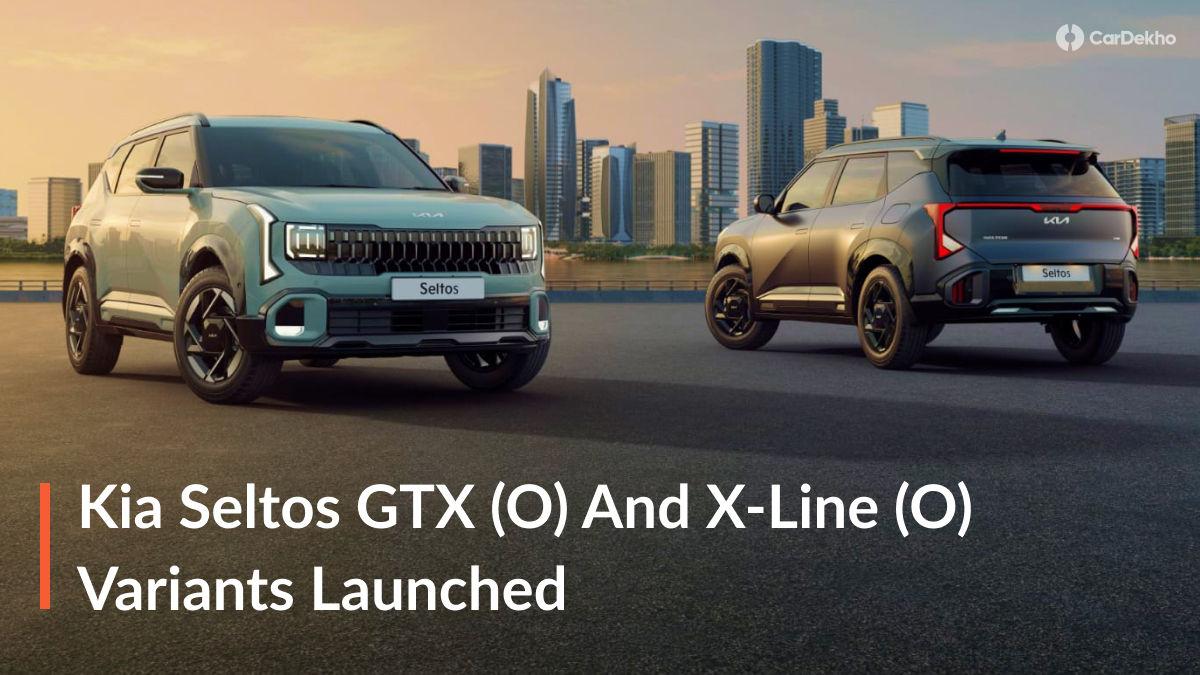
With a generational update for the Kia Seltos, the Korean carmaker has taken a radical approach to its styling, and this is something that will be applicable on the upcoming Hyundai Creta too. Read about the evolution of the Kia Seltos in this story.
On the other hand, the German brand Volkswagen has also given its Taigun compact SUV an update, but the changes are more of an evolution than revolution.
In this story, we take a look at the styling differences between the two SUVs, and also compare their features and powertrain options.
Kia Seltos vs Volkswagen Taigun: Exterior Design
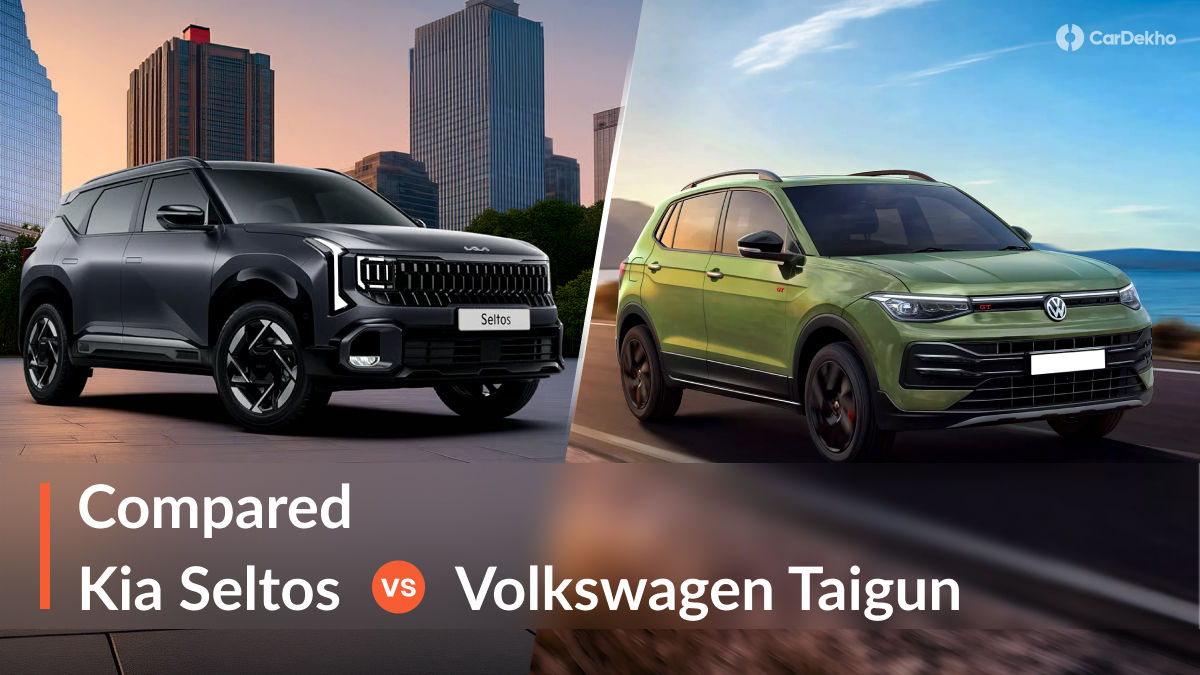
The design approach for the new-generation Kia Seltos and the facelifted Volkswagen Taigun are very different. The Korean SUV has proper macho looks which radiate a better road presence, while the German SUV’s charm lies in its sophistication.
Front
The design differences between the two SUVs are very apparent at the front where the Kia Seltos looks imposing with its flat nose, dominated by a chunky grille that almost spans the entire width. The grille also incorporates the headlights, while the sleek LED DRLs are placed right at the edge. The bumper on the Seltos too looks chunky with a horizontal air inlet flanked by boxy body-coloured inserts that add some muscle to it. A silver finish on the front lip adds a slight contrast to the black inserts.

On the flipside, the Taigun looks far from intimidating. It has sleek headlights, connected by its new LED DRL that meets at the illuminated VW logo. While there is a sleek grille behind the LED DRLs, the main airflow is down below, which is split by a panel with varying chrome or blacked out inserts, depending on the variant. In the GT plus variants, you also get a GT badge on the upper grille.
Side
In profile, while the Kia Seltos has a lot going on, the Volkswagen Taigun keeps things fairly simple. In the Kia, you’ll find heavy and chunky piano black inserts around the wheel arches, cuts and creases on the body, and some mixed cladding on the side sills too. It sits on 18-inch alloy wheels (finished in a dual-tone/black depending on the trim), which have a lot of interesting geometric shapes within them. Other design details include roof rails, motorised flush door handles and the floating effect through the C-pillar glass.
The Taigun, on the other hand, just looks simple. It doesn’t get any butch cladding or chunky wheel arches. It sits on 17-inch alloy wheels (dual-tone/black finish depending on the variant), gets conventional door handles and a roof rail. Depending on the variant, you get chrome or blacked out inserts on the door handles and roof rails, along with a GT badge on the fender.
Overall, the size difference between the two cars is also very apparent as the Seltos is the biggest car in its segment, and boasts an additional 239mm of length over the Taigun.
Rear
Both the cars take a very similar approach for their styling at the rear with connected LED tail lights, roof-mounted spoiler, shark fin antenna and contrasting inserts on the bumper. However, the Taigun also gets an illuminated logo which looks really chic at night, while the Seltos’ premium quotient is rendered via its contrasting piano black elements. They look nice, but will be hard to maintain over the course of your ownership, and we would recommend you to consider a PPF coating for longevity.
Kia Seltos vs Volkswagen Taigun: Interior Design
The stark difference in design continues as you step inside the cabin of the Kia Seltos and Volkswagen Taigun. With its facelift, the Taigun’s interior hasn’t changed much with a simple layered dashboard design which can either be had in dual-tone or all-black finish, depending on the variant. It gets a touch-sensitive AC control panel with a few physical buttons above, and its seats are draped in leatherette upholstery. Its infotainment system gets its own housing in the middle, while the driver’s display sits in a separate binnacle. The three-spoke steering wheel is shared with other Volkswagen cars and while the non-GT Plus variant feels classy, the all black theme, aluminium finish on the brake pedals and use of red ambient lighting in the GT Plus variants feels properly sporty.
The interior of the Kia Seltos in comparison looks busy and arguably, even a little dull with a grey finish for the dashboard. You only find a dual-tone treatment on the steering wheel, door pads, seats and central armrest. Here too, the design is layered, but unlike the VW, you get physical buttons and toggles for all daily-use features. Another differentiating factor is that the infotainment and driver’s screen is on the same panel, and there’s also a small separate 5-inch screen that just controls the air con settings.
Overall, the approach to the interior of the Volkswagen Taigun and Kia Seltos are very different, and it is hard to grant a verdict purely on the basis of design. Both have their own charms and nuances that will suit different people independently.
Features
The compact SUV segment has really moved on in terms of its feature experience, and most cars in it pack enough equipment to shame a few entry-level luxury offerings. The Kia Seltos is definitely one of those cars that have pushed segment boundaries constantly, while the Volkswagen Taigun remains to be a sensible car that focuses more on usable rather than fancy features.
Common features between the two cars include keyless entry, push button start/stop, auto headlights, rain sensing wipers, a panoramic sunroof, powered and ventilated front seats, connected car technology, type-C charging ports, wireless phone charging, ambient lighting, and automatic climate control. Both the cars feature digital screens, but while the Taigun gets a 10.1-inch infotainment touchscreen and a 10.25-inch digital driver’s display, the Kia Seltos boasts a bigger 12.3-inch touchscreen for both infotainment and the driver. It also additionally gets a 5-inch touchscreen for AC settings.
It’s not just the screens that are bigger in the Setlos as you get better convenience with 10-way powered adjustment with memory function and lumbar adjustment for the driver (Taigun gets 6-way only), auto-dipping ORVM, an 8-speaker Bose sound system instead of 6-speakers and dual-zone climate control.
So while the Taigun gets everything you will need, the Seltos goes a step beyond and offers you a better experience with more convenience.
Safety
Both the Volkswagen Taigun and Kia Seltos come with features like 6 airbags, ABS with EBD, electronic stability control, ISOFIX mounts and rear parking sensors as standard. Critically, the Taigun also offers important safety features like rear defogger, wiper and washer as standard as well, something that the Seltos only offers from its HTK variant.
However, in the top-spec variant, the Seltos’ safety kit is stronger with features like Level-2 autonomous driving assistance systems (ADAS), side parking sensors and 360-degree camera.
While the Seltos has a full five star crash test rating from Bharat NCAP, the Taigun hasn’t been crash tested by BNCAP, but had received a 5 star rating from Global NCAP in 2022.
Kia Seltos vs Volkswagen Taigun: Powertrains
| Specification |
2026 Volkswagen Taigun |
Kia Seltos |
|||
| Engine |
1-litre turbo-petrol |
1.5-litre turbo-petrol |
1.5-litre naturally aspirated petrol |
1.5-litre turbo-petrol |
1.5-litre diesel |
| Cylinders |
3 |
4 |
4 |
4 |
4 |
| Power |
115 PS |
150 PS |
115 PS |
160 PS |
116 PS |
| Torque |
178 Nm |
250 Nm |
144 Nm |
253 Nm |
250 Nm |
| Transmission |
6-speed MT / 8-speed AT^ |
7-speed DCT* |
6-speed MT/CVT^ |
6-speed iMT** / 7-speed DCT* |
6-speed MT / 6-speed AT^^ |
*DCT - Dual-clutch transmission, ^=Continuously variable transmission, ^^AT - Torque converter automatic transmission, **= Clutchless manual transmission
While the Volkswagen Taigun is a turbo-petrol-only offering, Kia offers a variety of engine options with the Seltos: A NA petrol, turbo-petrol and even a diesel.
Both the turbo-petrol engines in the Taigun offer the option of an automatic transmission and have usable performance for both city and highway drives. The option of a manual is only available with the smaller engine.
In the Seltos, all the engines are available with automatic transmissions, albeit of different kinds, and you get a proper manual with the NA petrol and diesel engine. The turbo-petrol gets a clutchless manual transmission (iMT).
Kia Seltos vs Volkswagen Taigun: Price
| Volkswagen Taigun |
Kia Seltos |
|
| Price (ex-showroom) |
Rs 11 lakh to Rs 19.30 lakh |
Rs 10.99 lakh to Rs 19.99 |
The Kia Seltos and Volkswagen Taigun are priced very similarly. At the top end, the Seltos is more expensive with a premium of Rs 69,000.
Verdict
The Kia Seltos and the Volkswagen Taigun are two very different compact SUVs, not just in the way they are designed, but also in the way they are packaged with different creature comforts, safety tech and powertrain options.
If you’re a family guy, then the larger size and the consequent space that comes with it might be able to accommodate four or more occupants in more comfort. Even in terms of the on-paper specifications like features, safety and powertrains, the Seltos gives you more conveniences and options to choose from, making it a great option that’ll suit different needs.
However, the strengths of the Volkswagen Taigun are something you can’t really put on a brochure. It has all the fundamental equipment you’d expect from a car at this price, along with a few feel-good features, but it’s the way it manages to deliver driving thrills while keeping its occupants comfortable is where it excels. A thorough verdict will require a real-world comparison between the two, so stay tuned for that. But as far as this on-paper story is concerned, the Kia Seltos has the upper hand.
Other cars to consider:
Hyundai Creta: A comfortable all-rounder with multiple powertrain options to choose from, making it a suitable option for virtually every need. Here’s how it compares against the new Kia Seltos.
Renault Duster: One of the best ride and handling dynamic balance in the entire segment with a strong safety and powertrain package. Doesn’t get a diesel or the option of a hybrid powertrain yet.
Skoda Kushaq: Similar traits as the Volkswagen Taigun with European ride and handling manners, just in a different style and design. (Seltos vs Kushaq)
Maruti Grand Vitara/Toyota Hyryder: A compact SUV that focuses on comfort, practicality, and ease of use. Not the most premium or feature-loaded, but definitely one of the most fuel efficient cars in the segment with its hybrid powertrain. (Seltos vs Hyrdyer)
Read a comparison between the Maruti Grand Vitara and Kia Seltos here.
If you want similar traits as the Maruti Grand Vitara, but in a more modern form, then check out the Maruti Victoris, and read about its differences with respect to the Kia Seltos here.
MG Astor: One of the most premium cabin experiences at its price point, but doesn’t offer much in terms of features or powertrain options. Astor vs Kia Seltos compared here.
Honda Elevate: A safe, sensible and reliable option in the segment with good space, practicality and sorted balance between ride and handling. Honda Elevate vs Kia Seltos compared here.
Tata Curvv: Multiple powertrain options, a strong feature and safety package along with its unique SUV-coupe bodystyle make it a great option for someone who wants to stand out. Not the most practical or spacious, though. Tata Curvv vs Kia Seltos compared here.
Tata Sierra: An SUV that pushes segment boundaries in terms of its design, features, safety kit while offering multiple powertrain options to choose from.Tata Sierra vs Kia Seltos compared here.