

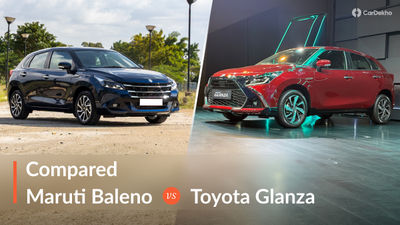
2026 Maruti Suzuki Baleno Facelift vs Toyota Glanza Facelift: Here’s What’s Similar And Different Between The Two
The Baleno and Glanza facelift have a lot of similarities, but pricing and styling differences could sway a buyer’s decision.
- Baleno prices range from Rs 6.10–9.99 lakh, undercutting the Glanza’s Rs 6.99–10.98 lakh by Rs 89,000–99,000.
- Both share a 1.2-litre three-cylinder engine, petrol and CNG options, five-speed manual or AMT gearboxes, and identical claimed efficiency figures.
- Both facelifts add ventilated front seats, wireless charging and six-speaker audio, alongside Level-2 ADAS, a 360-degree camera and six airbags.
| We are helping 50 of our lucky readers with a personalised car buying journey. You will be able to speak directly to an automotive expert and get all your doubts answered. Fill this form and if you are one of those lucky customers, we’ll get in touch with you soon. |
The Maruti Suzuki Baleno and Toyota Glanza might be cut from the same cloth, but there’s a lot that differentiates the two. The Baleno was the first to receive a facelift this year, followed shortly after by the Glanza. They share the same powertrains, features and safety kit, so how does the Maruti-badged sibling differ from the Toyota? We find out:
Price
| Model |
Maruti Suzuki Baleno |
Toyota Glanza |
| Price (ex-showroom) |
Rs 6.10 lakh - Rs 9.99 lakh |
Rs 6.99 lakh - Rs 10.98 lakh |
It’s pretty clear from the table that the Baleno undercuts the Glanza by close to a lakh at the entry level. As both cars share their mechanicals and offer largely identical equipment, the Baleno is enticing for buyers looking to get maximum bang for their buck.
Exterior
The Baleno gets a prominent chrome grille, with the Maruti Suzuki logo positioned prominently. The Glanza, meanwhile, is more Lexus-esque in its appearance – a large V-shaped grille, a Toyota badge on the bonnet and rectangular LED fog lamps integrated into its redesigned bumper. Both cars retain projector LED headlamps and their signature daytime running lights.
The facelift gives the Baleno a more assertive front-end, while the Glanza’s styling looks more premium. The Toyota also gets a front bumper lip, giving it a distinct visual identity.
The similarities are much more apparent from the side. Both hatchbacks retain their familiar proportions – a 2,520mm wheelbase and 16-inch dual-tone alloy wheels. The Baleno features a chrome finish on the door handles, window surrounds and front fender. While these elements are present on the Glanza too, the Toyota one-ups the Baleno by offering a sporty gloss black side skirt.
At the rear, the two cars are nearly identical – C-shaped LED tail-lamps, a chrome strip connecting the rear design elements, a roof-mounted spoiler, similar bumper designs and a rear wiper-washer.
Colour Options
Both the Baleno and the Glanza are offered with 7 monotone shades.
| Maruti Suzuki Baleno Facelift |
Toyota Glanza Facelift |
| Arctic White |
Cafe White |
| Grandeur Grey |
Gaming Grey |
| Splendid Silver |
Enticing Silver |
| Opulent Red |
Sportin Red |
| Bluish Black |
Bluish Black |
| Nexa Blue |
Insta Blue |
| Enigmatic Teal Green |
Digital Teal Green |
The colour options available on both hatchbacks are the same; they just differ in nomenclature.
Interior
The Baleno gets a black-and-blue cabin theme on the inside with silver accents, giving the dashboard a sportier appearance, while the Glanza uses a black-and-beige theme with gloss-black highlights, creating an impression of a cabin that’s more spacious. Apart from these differences, the dashboard design and overall layout are shared between the two.
Both cars feature a floating touchscreen infotainment system, an analogue instrument cluster and a revised lower centre console to accommodate the wireless phone charger and ventilated front seats. Both retain physical controls for the air conditioning and get steering-mounted buttons.
In terms of cabin space and comfort, there is little to distinguish the two apart from the fact that the Baleno’s darker cabin theme may appeal to buyers who prefer a sportier ambience.
One feature that’s missing on both, however, is a single-pane sunroof.
Rivals such as the Tata Altroz and Hyundai i20 offer this feature, which could have added to the premium feel of the updated hatchbacks.
Features And Safety
The Baleno receives several new features with the facelift, including ventilated front seats, a wireless phone charger and a 6-speaker Clarion sound system, which have been carried over on the Toyota. Speaking of which, features like a 9-inch touchscreen infotainment with wireless Android Auto and Apple CarPlay, an analogue instrument cluster with multi-information display, automatic climate control, keyless entry with push-button start, a heads-up display, cruise control, electrically adjustable and foldable ORVMs, and connected car technology are also shared between the two.
Safety equipment is another area where the two hatchbacks are evenly matched.
Apart from Level-2 ADAS features like adaptive cruise control (ACC), lane-keep assist (LKA), lane departure warning (LDW), forward collision warning (FCW) and automatic emergency braking (AEB), both get a 360-degree camera, six airbags, ABS with EBD, hill-hold control (HHC), a tyre-pressure monitoring system (TPMS), an auto-dimming IRVM and ISOFIX child-seat mounts.
Powertrain Options
Both hatchbacks are powered by Maruti Suzuki’s Z-series 1.2-litre, three-cylinder petrol engine, which also does duty in the Swift and Dzire. The facelifted versions continue to offer petrol and CNG options, along with manual and AMT gearbox choices.
Here is a closer look at their powertrain specifications:
| Specification |
Petrol |
Petrol + CNG |
| Engine |
1.2-litre, three-cylinder, naturally aspirated petrol |
1.2-litre, three-cylinder, naturally aspirated petrol with CNG |
| Power |
83 PS |
70 PS |
| Torque |
112 Nm |
102 Nm |
| Transmission |
5-speed MT / 5-speed AMT |
5-speed MT / 5-speed AMT |
| Claimed fuel efficiency (ARAI) |
23.80kmpl (MT) / 24.77kmpl (AMT) |
33.61km/kg (MT) / 34.47km/kg (AMT) |
MT - Manual Transmission, AMT - Automated Manual Tranmsission
With identical engine and transmission options, the choice between the two is unlikely to come down to performance or claimed fuel efficiency. Instead, pricing, styling preferences and the ownership experience would play a bigger role.
CarDekho Says…
The Maruti Suzuki Baleno and Toyota Glanza are closely related hatchbacks, but the Baleno has a clear advantage when it comes to pricing. It offers the same features, safety equipment and powertrain options as the Glanza, while costing around Rs 89,000 and Rs 99,000 less at the entry level and top end, respectively.
If saving money is high on your priority list, the Baleno makes more sense. You get pretty much the same package as the Glanza, but at a lower price. The Glanza is worth considering if you’d rather go with Toyota and are more comfortable with its service network. But if it were our money, we’d pick the Baleno and save the extra cash.
Other Options To Consider
Hyundai i20: A premium hatchback with a feature-rich cabin and a refined petrol engine. It also stands out for offering a four-cylinder petrol engine, unlike the three-cylinder units in the Baleno and Glanza.
Tata Altroz: An alternative for buyers who want a premium hatchback with strong safety credentials and a distinctive design. It’s also the only hatchback to get an oil burner, giving it an advantage for buyers specifically looking for a diesel engine.