

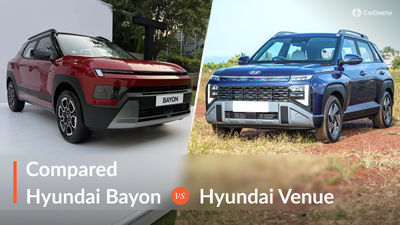
2026 Hyundai Bayon Vs Hyundai Venue: Find Out Which Hyundai SUV Is A Better Buy And Why
Hyundai has just launched its latest compact SUV, the Bayon, but does it offer better value than the smaller Venue?
The 2026 Hyundai Bayon has been launched in the Indian market, with a starting price tag of Rs 9.99 lakh (ex-showroom). The new Bayon sits between the Venue and Creta, and is offered exclusively with a single petrol engine option. In today's comparison, we put the new Hyundai Bayon against the Hyundai Venue, which, for reference, is sold with two petrol and a diesel engine option. While the Bayon is the bigger one, the Venue gives strong competition, given its presence in the market since 2019, along with reliability and comfort around this price range.
While both cars share a similar price range and cater to buyers looking for a feature-loaded, comfortable, and practical family car with a spacious cabin along with various powertrain options, they differ in terms of design, pricing, features, and overall value proposition. Let’s compare the Hyundai Bayon and the Hyundai Venue:
Price
| Model |
Hyundai Bayon |
Hyundai Venue |
| Price (Petrol) |
Rs 9.99 lakh to Rs 17.99 lakh |
Rs 7.99 lakh to Rs 14.99 lakh |
| Price (Diesel) |
- |
Rs 9.94 lakh to Rs 15.82 lakh |
(all prices ex-showroom)
-
As we can see, the Hyundai Venue is the more economical choice of the two cars.
-
The Hyundai Bayon is offered with a total of 7 variants, spread across a single petrol engine with manual and automatic transmission options.
-
The Venue starts at a lower Rs 7.99 lakh (ex-showroom) price for the base petrol variant and goes up to Rs 15.82 lakh (ex-showroom) for the top-spec diesel AT variant.
-
On the other hand, the Bayon starts at a higher Rs 9.99 lakh (ex-showroom) for the base petrol variant and goes up to Rs 17.99 lakh (ex-showroom) for the top-spec petrol CVT variant.
-
The top-spec variants of the Bayon cost Rs 2.17 lakh more than the Venue. For the Bayon’s full price list, check out this link.
-
Both cars cater to a similar audience, but carry a huge price difference. They also differ in the amount of space and features they offer.
Let’s find out what you get in each car for similar money:
Dimensions
| Parameter |
Hyundai Bayon |
Hyundai Venue |
Difference |
| Length |
4245 mm |
3995 mm |
+ 250 mm |
| Width |
1810 mm |
1800 mm |
+ 10 mm |
| Height |
1605 mm |
1665 mm |
(- 60 mm) |
| Wheelbase |
2600 mm |
2520 mm |
+ 80 mm |
| Boot space |
505 litres |
375 litres |
+ 130 litres |
-
As seen in the comparison table, the Hyundai Bayon is the overall larger SUV of the two, being larger in almost every dimension, including length, width, and wheelbase, which could translate to a significantly more spacious cabin.
-
The Venue boasts a slightly taller height but a very similar width to the Bayon.
-
The difference between the dimensions of the two SUVs is expected, as the Venue sits in the sub-4m SUV segment, while the Bayon sits a segment above.
-
In terms of boot space, the Bayon offers a significantly larger 505-litre boot, which means you can carry big suitcases and more luggage with ease.
Explore More
Top 10 Most Affordable Cars With Ambient Lighting: Premium Interior Feel Is Available In Small Car BudgetColour Options
| Hyundai Bayon |
Hyundai Venue |
| Atlas White* |
Atlas White* |
| Ecotronic Grey |
Titan Grey |
| Titanium Black^ |
Abyss Black |
| Golden Bronze |
Mystic Sapphire^ |
| Classy Blue^ |
Hazel Blue*^ |
| Fiery Red* |
Dragon Red |
* - Also available with a dual-tone Black roof
^ - Also available in Matte finish
-
Both cars get 6 colour options, which include a set of monochrome and bright colours.
-
Some colours of both cars can be had with a dual-tone roof treatment.
-
The Bayon offers the choice of matte finish on two colour options: Titanium Black and Classy Blue, while the same is true for the Venue on the Mystic Sapphire and Hazel Blue shades.
Features And Safety
| Feature |
Hyundai Bayon |
Hyundai Venue |
| LED Headlamps |
✅ |
✅ |
| LED DRLs |
✅ |
✅ (connected) |
| LED Taillamps |
✅ |
✅ (connected) |
| Wheels |
17-inch alloy wheels |
16-inch alloy wheels |
| Roof Rails |
✅ |
✅ |
| Shark Fin Antenna |
✅ |
✅ |
| Infotainment |
10.25-inch touchscreen |
12.3-inch touchscreen |
| Wireless Apple CarPlay / Android Auto |
✅ |
✅ |
| Instrument Cluster |
12.3-inch fully digital |
12.3-inch fully digital |
| Wireless Phone Charger |
✅ |
✅ |
| Sound System |
8-speaker BOSE |
8-speaker BOSE |
| Push-button start/stop |
✅ |
✅ |
| Cabin Theme |
Dual-tone Black and Olive Grey / all-Black with Red accents^ |
Dual-tone Dark Navy and Dove Grey |
| Leatherette Upholstery |
✅ |
✅ |
| Leatherette-wrapped Steering Wheel |
✅ |
✅ |
| Steering Adjustment |
✅ (Tilt Telescopic) |
✅ (only Tilt) |
| Steering-Mounted Audio Controls |
✅ |
✅ |
| Ventilated Front Seats |
✅ |
✅ |
| Driver Seat Adjustment |
✅ (8-way electric) |
✅ (4-way electric) |
| Adjustable headrests |
✅ |
✅ |
| Reclining Rear Seats |
✅ (2-step) |
✅ (2-step) |
| Rear centre armrest with storage |
✅ |
✅ |
| Rear Window Sunshades |
❌ |
✅ |
| Paddle Shifters |
✅ |
✅ |
| Connected Car Tech |
✅ |
✅ |
| Cruise Control |
✅(Adaptive) |
✅(Adaptive) |
| Sunroof |
✅(Panoramic) |
✅(Single-pane) |
| Automatic Climate Control |
✅ |
✅ |
| Rear AC vents |
✅ |
✅ |
| Automatic Headlights |
✅ |
✅ |
| Rain Sensing Wipers |
✅ |
✅ |
| Ambient Lighting |
✅ |
✅ |
| Cooled Glove Box |
✅ |
✅ |
| Keyless Entry |
✅ |
✅ |
| Dashcam |
✅ |
❌ |
| Airbags |
6 |
6 |
| ADAS (Advanced Driver Assistance Systems) |
✅ (Level-2) |
✅ (Level-2) |
| Drive Modes |
✅ (CVT only) |
✅ (Eco, Normal, Sport) |
| Traction Modes |
❌ |
✅ (Sand, Mud, Snow) |
| Parking Sensors |
Front and rear |
Front and rear |
| Parking Camera |
✅ (360-Degree) |
✅ (360-Degree) |
| Blind View Monitor |
✅ |
✅ |
| Tyre Pressure Monitoring System (TPMS) |
✅ |
✅ |
| Electronic Stability Program (ESP) |
✅ |
✅ |
| Traction Control System (TCS) |
✅ |
✅ |
| All-wheel disc brakes |
✅ |
✅ |
| Electronic parking brake with auto-hold (EPB) |
✅ |
✅ |
| Hill Hold Control (HHC) |
✅ |
✅ |
| Auto-dimming IRVM |
✅ |
✅ |
| Electrically Adjustable Foldable ORVMs |
✅ |
✅ |
| Rear Defogger |
✅ |
✅ |
| ISOFIX Child Seat Mount |
✅ |
✅ |
^For variants finished in dual-tone exterior
-
As seen in the comparison table above, both cars are very well equipped and neck and neck in terms of features, convenience, and safety offered. Common features include touchscreen infotainment systems with wireless Android Auto and Apple CarPlay, electrically adjustable driver seats, ventilated front seats, cruise control, automatic headlights, automatic climate control, rear AC vents, a Level-2 ADAS suite, a 360-degree camera, leatherette upholstery, and 6 airbags.
-
On the outside, the Venue features a connected light bar at the front and rear, while riding on smaller 16-inch alloy wheels, as compared to the 17-inch ones offered on the Bayon.
-
The cabins of both cars feel premium with a dual-tone theme and leatherette upholstery. The Venue additionally offers rear window sun shades.
-
In terms of driving, the Venue offers both drive and traction modes.
-
The Bayon has its own set of advantages; for instance, it offers a larger panoramic sunroof, 8-way electric adjustment for the driver's seat, both tilt and telescopic adjustment for the steering wheel, and a built-in dashcam, which are absent on the Venue.
-
To sum up, both cars are very similarly equipped, but considering the price, the Hyundai Venue does have an edge here. The Hyundai Bayon does not fall behind either; you do get additional features for the price premium.
Powertrain Options
In terms of powertrain options, the Hyundai Bayon is offered with a single engine option, which is a 1.5-litre naturally aspirated petrol engine, available with both a manual and a CVT automatic transmission.
On the other hand, the Hyundai Venue is offered with three engine options. These include a 1.2-litre naturally aspirated engine, a 1-litre turbocharged petrol engine, and a 1.5-litre diesel engine. This helps the Venue give buyers a wider range of powertrain options to choose from.
Here’s a quick look at all the powertrain options in detail:
| Model |
Hyundai Bayon |
Hyundai Venue |
||
| Engine |
1.5-litre naturally aspirated Petrol |
1.2-litre naturally aspirated petrol |
1-litre turbo-petrol |
1.5-litre diesel |
| Power |
115 PS |
83 PS |
120 PS |
116 PS |
| Torque |
144 Nm |
115 Nm |
172 Nm |
250 Nm |
| Transmission |
6-speed MT / CVT |
5-speed MT |
6-speed MT / 7-speed DCT |
6-speed MT / 6-speed AT |
MT- Manual transmission; CVT- Continuously Variable Transmission (automatic); DCT- Dual-Clutch Transmission (automatic); AT- Automatic Transmission (torque converter)
-
The Hyundai Bayon offers a single petrol engine option, but the Venue has the advantage here, with a choice of three engine options.
-
The economical pricing and the availability of a diesel engine are one of the main advantages of the Hyundai Venue.
-
A turbo petrol engine and a diesel engine option are missing on the Hyundai Bayon.
-
When comparing the naturally aspirated petrol powertrains of both cars, the Bayon has a larger displacement engine, and hence provides considerably more power and torque.
-
Considering the price range both cars belong to, the engine options on the Venue seem like the overall better deal, but the Bayon is not far behind. The 1.5-litre engine on the Bayon is already doing duty in cars like the Creta, Seltos, and Verna, and hence has a reliable image. Hyundai has confirmed that the Bayon is getting CNG powertrains by January 2027.
CarDekho Says…
The Hyundai Bayon has a clear advantage over the Hyundai Venue in terms of size, boot space, and cabin comfort. It is 250 mm longer and gets an 80mm longer wheelbase, while its 505-litre boot is 130 litres larger than the Venue's. The Bayon also gets a more powerful naturally aspirated petrol engine than the Venue's standard petrol unit, along with a CVT automatic option. However, the Venue offers a wider choice of powertrains, including a turbo-petrol and a diesel engine, making it more suitable for buyers who prioritise performance or want the added efficiency and long-distance touring ability of a diesel.
Both SUVs offer a well-equipped cabin with a touchscreen infotainment, digital instrument cluster, ventilated front seats, an 8-speaker Bose sound system, a 360-degree camera, and Level-2 ADAS. However, the Bayon gets a larger panoramic sunroof, an 8-way electrically adjustable driver's seat, a tilt-and-telescopic steering wheel, and a dashcam. The Venue counters with a larger 12.3-inch infotainment screen, rear window sunshades, selectable drive and traction modes, and connected light bars on the outside.
With prices starting at Rs 9.99 lakh, the Hyundai Bayon commands a Rs 2 lakh premium over the Venue's entry-level petrol variant. It also costs more at the top end, with prices reaching Rs 17.99 lakh compared to the Venue's Rs 14.99 lakh for petrol variants. The Bayon makes a stronger case for buyers seeking a larger, more spacious petrol SUV with added comfort and premium features. However, the Hyundai Venue remains the more versatile and affordable choice, thanks to its lower starting price, wider powertrain options, and useful features. For most buyers, the Venue makes more sense as an all-rounder, while the Bayon is worth considering if space and cabin comfort take priority.
Which one of the two offerings from Hyundai do you like more? Let us know in the comments!
Other Options To Consider
The Hyundai Bayon and Hyundai Venue are both great products in their respective domains. While the Venue has been in India since 2019 and already has a loyal customer base, the Bayon has a long way to go to establish itself, but it looks equally capable. But you can still have a look at some of the alternatives to these cars in the segment and what they bring to the table:
-
Hyundai Creta: India’s top-selling mid-size SUV that is set to receive a new generation early next year, and offers a well-rounded package with a long list of features, a comfortable ride, and a wide range of powertrain options.
-
Kia Seltos: A good alternative if you want a feature-loaded SUV with a premium cabin, a reliable brand image, and multiple engine and gearbox options to choose from.
-
Renault Duster / Nissan Tekton: For their spot-on balance between ride, handling, and performance, combined with dominating appeal and strong road presence.
-
Honda Elevate: For its new design, updated list of features with rear ventilated seats, a smooth petrol engine, robust ride quality, and a spacious cabin.
-
Tata Sierra: For its retro-themed design, a spacious interior, and multiple engine options along with a segment-leading feature list.
-
Maruti Victoris: Best suited for buyers looking for hassle-free and reliable ownership with a distinctive design, affordable after-sales, strong fuel efficiency with hybrid tech, a feature-loaded and spacious cabin, and optional AWD.
-
Maruti Grand Vitara / Toyota Urban Cruiser Hyryder: Everything that the Victoris offers, but in a more boxy and traditional SUV design.
-
Volkswagen Taigun / Skoda Kushaq: For their strong driving dynamics thanks to punchy turbo-petrol engines along with a high-performance DSG gearbox. They also offer sporty exterior styling with a premium and feature-loaded cabin.
-
Tata Curvv: For its unique coupe-SUV styling, offering a distinctive road presence along with a long list of features and a large boot.
-
MG Astor: It is now a dated option, but appeals to buyers not so keen on performance and who need a value-for-money, feature-loaded SUV with a spacious cabin.