

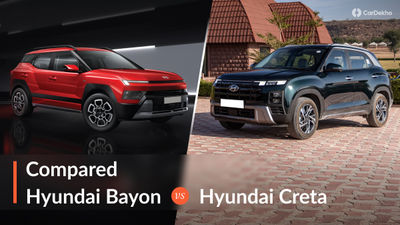
2026 Hyundai Bayon Vs Hyundai Creta: A Head-To-Head Comparison Between Cars From The Same Stable
The Bayon positions itself somewhere between the Venue and Creta in Hyundai’s India lineup
UPDATE: Hyundai India has launched the 2026 Bayon compact SUV from Rs 10 lakh (ex-showroom).
Hyundai’s newest compact SUV is all set to enter the populated compact SUV segment, positioning itself between the Venue and the Creta. The Bayon features a quirky new cabin, big dual screens and a long safety list, all in a rugged crossover body. The Creta, meanwhile, remains the segment king, with multiple variants, several powertrain options, and a car that is almost perfect for any Indian family.
In this report, we compare the two to see how they stack up, and whether the Bayon is enough to make you look past the Creta.
Price
| Model |
Hyundai Bayon (expected) |
Hyundai Creta |
| Price (ex-showroom) |
Rs 10 lakh to Rs 18 lakh |
Rs 10.91 lakh to Rs 20.46 lakh |
-
The Bayon’s pricing is yet to be announced. If it lands as expected, the base variant will sit very close to the Creta’s, but its top end will remain a few lakhs below.
-
The Creta’s range goes much higher because of its turbo-petrol and diesel variants.
-
In the first few months, the Bayon will hardly get any discounts. As an older model with a next-gen version due soon, the Creta should have more room for discounts.
Design
Compared to the Creta, the Bayon has a bolder, sharper face with sleek LED DRLs that skip the connected-light trend, with the headlamps placed below them. A silver skid plate on the bumper adds to its rugged look. The Creta’s front end is more premium and imposing, with its connected LED DRLs and larger overall presence. The Hyundai logo’s positioning is also different on both SUVs.
From the side, the Bayon looks more rugged and doesn’t have the conventional body style. It looks tough and chunky, with thick body cladding, muscular sculpting, 17-inch dual-tone alloys, black roof rails and a blacked-out B-pillar. The Creta is the bigger car at about 4.3 metres in length, while the Bayon sits at around 4.2 metres. It is important to note that the upcoming Creta is set to be based on a newer platform and will be larger at about 4.5 metres of length. The Creta’s top variants get larger 18-inch alloys.
At the rear, the Bayon gets LED taillights that mirror the front DRLs, a squared-off tailgate, an integrated roof spoiler and a silver skid plate with neatly integrated reverse lamps. The Creta’s rear is more conventional and wider-looking. The Bayon’s rear end might remind you of the Venue, mainly due to the aggressive styling and upright rear end.
Overall, the Bayon is the quirkier, more rugged-looking Hyundai, while the Creta looks more sophisticated.
Explore More
Hyundai Announces Price Hike For Select Models From December 1: Prices To Increase By Up To Rs 8,000Features
In the features department, the Bayon and Creta stand closely together. However, small differences between the two include the size of the screens on the dashboard. The Bayon gets larger 12.3-inch curved displays as opposed to the 10.25-inch displays in the Creta. The Bayon gets wireless Android Auto and Apple CarPlay, while the Creta does not.
Where the Creta has the upper hand is the dual-zone climate control as opposed to the single zone in the Bayon. The Creta also gets memory function for the front powered seats, which the Bayon is not expected to get.
However, both share a long list of features including LED lighting, panoramic sunroof, cruise control, wireless smartphone charging, USB-C fast charging, 8-speaker Bose sound system, ventilated front seats and connected car tech.
Safety wise, we also expect the two cars to be closely matched with a 360-degree camera, front and rear parking sensors, ISOFIX child seat mounts, Level-2 ADAS, electronic parking brake (EPB) with auto hold, 6 airbags and a tyre-pressure monitoring system.
Powertrain Options
| Model |
Hyundai Bayon |
Hyundai Creta |
||
| Engine |
1.5-litre naturally aspirated petrol |
1.5-litre naturally aspirated petrol |
1.5-litre turbo-petrol |
1.5-litre diesel |
| Transmission |
6-speed MT/IVT |
6-speed MT/IVT |
7-speed DCT |
6-speed MT/6-speed AT |
| Power |
115 PS |
115 PS |
160 PS |
116 PS |
| Torque |
144 Nm |
144 Nm |
253 Nm |
250 Nm |
MT - Manual Transmission, IVT - Intelligent Variable Transmission (automatic), DCT - Dual-Clutch Transmission (automatic), AT - Torque Converter (automatic)
-
The Bayon gets the same naturally aspirated petrol engine as the Creta, with identical power and torque figures. It is smooth, refined and well suited for city driving and relaxed highway runs.
-
The Creta is the clear winner if you want outright performance or the lower running costs of a diesel. The turbo-petrol with the DCT is much quicker, while the diesel suits buyers looking for better fuel efficiency and higher running.
-
Do note that unlike few of its rivals, neither SUV offer CNG from the factory.
Rivals
The two Hyundais sit in among the most fiercely competitive segments in the market. The rivals include the Kia Seltos, Renault Duster, Skoda Kushaq, Volkswagen Taigun, Maruti Victoris, Grand Vitara, Toyota Urban Cruiser Hyryder, Nissan Tekton, Tata Sierra, Tata Curvv, Citroen Aircross X, MG Astor and the Honda Elevate.
CarDekho Says
The Bayon is the more modern-feeling of the two. With larger screens, a fresh cabin, a long ADAS list and rugged looks, it makes a strong case for buyers who want a newer-feeling Hyundai without paying Creta money. A new name also gives Hyundai a new identity in the compact-SUV space.
The Creta still has a clear reason to exist, though. Its diesel and turbo-petrol engines, bigger size, more comfort features and proven reliability make it a better all-rounder, especially for highway use and family duty. It is also set to get bigger and better with the upcoming model, which could move it up by half a segment, price-wise..
We’d lean towards the Bayon for city-focused buyers who want the latest tech, but the Creta remains the pick for space, performance and powertrain choice.