
Nissan Tekton vs Maruti Victoris Specifications Compared: Two Polar Ends Of A Spectrum
Despite the dimensions, features, and safety similarities, the Nissan Tekton and Maruti Victoris are two very different SUVs, and the wrong choice could be a disaster for you


- Write a comment
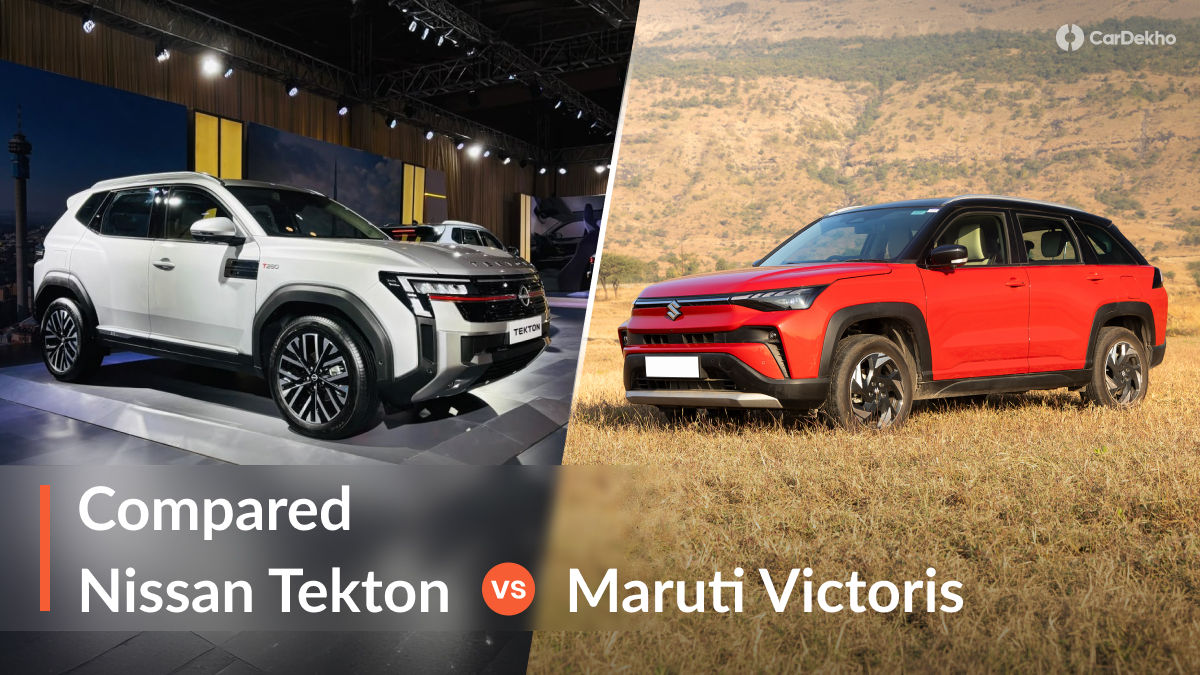
Nissan has just launched the Tekton in India, which is the rebadged avatar of the Renault Duster. It gets a slightly different design, but has the same features, safety and powertrain package as the Duster, except that there won’t be a hybrid coming later.
In case you do want a strong-hybrid, the Maruti Victoris is one of the options, which also happens to be a Japanese SUV, offering you similar features as the Nissan Tekton. But which one’s for you? Let’s take a detailed look at their specifications:
Price
| Car |
2026 Nissan Tekton |
Maruti Victoris |
| Price |
Rs 10.49 lakh to Rs 18.59 lakh |
Rs 10.50 lakh to Rs 19.99 lakh |
- The Nissan Tekton undercuts the Maruti Victoris at the top end by nearly Rs 1.4 lakh. This difference is likely due to the Maruti offering a strong-hybrid system, which is more expensive.
-
The starting prices of both the cars are very similar.
Dimensions
| Parameter |
2026 Nissan Tekton |
Maruti Victoris |
Difference |
| Length |
4349 mm |
4360 mm |
-11 mm |
| Width |
1815 mm |
1795 mm |
+20 mm |
| Height |
1674 mm |
1655 mm |
+19 mm |
| Wheelbase |
2657 mm |
2600 mm |
+57 mm |
| Boot Space |
700-litres |
NA |
NA |
- Maruti has not disclosed the boot space figures for the Victoris. But we can tell you that the hybrid variants have a relatively compromised boot space compared to the average car in the segment. Mild-hybrid variants offer slightly better space, but it still is on the lower end of the spectrum. In CNG, however, Maruti uses an underbody tank, so there isn’t the usual boot space compromise with that powertrain. In comparison, the Tekton, along with the Duster, has the biggest boot space in the segment, which measures 700 litres up to the roof.

-
Save for length, the Nissan Tekton is bigger than the Maruti Victoris in all the parameters.
-
Even the wheelbase in the Nissan is 57mm longer, despite the 11mm shortage in overall length.
-
The Tekton measures 20mm wider and 19mm taller than the Maruti Victoris.
Colour options
| 2026 Nissan Tekton |
Maruti Victoris |
| Onyx Black |
Eternal Blue* |
| Blade Silver* |
Sizzling Red* |
| Pearl White* |
Mystic Green |
| Flare Garnet Red* |
Bluish Black |
| Indigo Blue* |
Magma Grey |
| Moonbow Gray* |
Splendid Silver* |
| - |
Arctic White |
*Also offered with optional dual-tone scheme with black roof
-
The number of colour options in the Maruti Victoris is more than what the Nissan Tekton gets. But the Maruti only gets three shades with a dual-tone black roof option, while the Tekton gets five shades.
-
You can check out all colours of the Tekton, along with its variant-wise split here.
-
Both the cars have a very similar colour palette.
Features
| Feature |
2026 Nissan Tekton |
Maruti Victoris |
| LED Headlamps |
✅ |
✅ |
| Auto Headlamps |
✅ |
✅ |
| LED DRLs |
✅ |
✅ |
| LED Front Foglamps |
✅ |
✅ |
| Roof Rails |
✅ |
✅ |
| LED Taillamps |
✅ |
✅ |
| Alloy wheels |
18-inch |
17-inch |
| Powered front seats |
✅6-way (Driver/Co-driver) |
✅(8-way driver) |
| Ventilated front seats |
✅ |
✅ |
| Infotainment |
10.1-inch touchscreen with Google OS |
10.1-inch touchscreen |
| Wireless Apple CarPlay/Android Auto |
✅ |
✅ |
| Instrument Cluster |
10.25-inch Digital with Google OS |
10.25-inch digital display |
| Wireless Phone Charger |
✅ |
✅ |
| Sound system |
6-speaker |
8-speaker Infinity sound system |
| Auto-dimming IRVM |
✅ |
✅ |
| Cruise Control |
✅(Adaptive) |
✅(Adaptive) |
| Automatic Climate Control |
✅(Dual-zone) |
✅(single-zone) |
| Powered tailgate |
✅ |
✅ |
| Keyless entry |
✅ |
✅ |
| Sunroof |
Panoramic |
Panoramic |
| Rear sun shade |
❌ |
✅ |
| Front and rear centre Armrest |
✅ |
✅ |
| Head-up display |
❌ |
✅ |
| Split-folding rear seats |
✅ |
✅ |
| Drive Modes |
3 (Eco/Comfort/Perso) |
3 (Eco/Normal/Sport) |
| Connected Car Tech |
✅ |
✅ |
| Airbags |
6 |
6 |
| Parking sensors |
Front and Rear |
Front and Rear |
| Parking Camera |
360-degree |
360-degree |
| ESC (electronic stability control) |
✅ |
✅ |
| EPB (electronic parking brake) with auto hold |
✅ |
✅ |
| Rain-sensing wipers |
✅ |
✅ |
| All-wheel disc brakes |
✅ |
✅ |
| Rear wiper and washer with defogger |
✅ |
✅ |
| Hill hold assist |
✅ |
✅ |
| TPMS (Tyre Pressure Monitoring System) |
✅ |
✅ |
| ADAS (advanced driver assistance systems) |
✅ (level-2) |
✅ (level-2) |
- The Nissan Tekton and Maruti Victoris are well loaded with functional and modern-day features, with only a few discretionary misses over each other.
-
The Tekton boasts one size larger alloy wheels at 18 inches, compared to the Victoris’ 17-inch wheels.
-
Compared to the Victoris, the Tekton misses out on a head-up display, rear sun shades, and an 8-speaker branded audio system.
-
While the Victoris only gets an 8-way powered driver’s seat, both the front seats in the Tekton are powered, but only 6-way adjustable.
-
Both cars have a similar safety package, save for the Tekton also getting parking sensors in profile.
Powertrain
| Specification |
2026 Nissan Tekton |
Maruti Victoris |
|||
| Engine |
1-litre turbo-petrol |
1.3-litre turbo-petrol |
1.5-litre petrol CNG |
1.5-litre NA petrol |
1.5-litre Strong Hybrid |
| Power |
100 PS |
163 PS |
88 PS |
103 PS |
116PS (combined) |
| Torque |
166 Nm |
280 Nm |
121.5 Nm |
137 Nm |
141Nm (Hybrid) |
| Transmission |
6-speed MT |
6-speed MT/6-speed DCT* |
5-speed MT |
5-speed MT / 6-speed AT |
e-CVT^ (single-speed gearbox) |
| Drivetrain |
FWD |
FWD |
FWD |
FWD/AWD(AT only) |
FWD |
| Fuel efficiency (claimed) |
19.4 kmpl |
17.8 kmpl (MT)/18.5 kmpl (DCT) |
27.02 km/kg |
21.18 kmpl (MT) 21.06 kmp (AT)/l19.07 kmpl (ATAWD) |
28.65 kmpl |
*DCT= Dual-clutch automatic transmission, ^CVT= Continuously variable transmission
-
Nissan and Maruti take two very different approaches to their powertrain options. The Tekton is a turbo-petrol-only offering with two different engines to choose from, while Maruti focuses on efficiency with a CNG, mild-hybrid and a strong-hybrid option.
-
An automatic dual-clutch transmission is only available with the Tekton’s bigger engine. The Victoris gets a torque converter automatic in the mild-hybrid and an e-CVT with the hybrid.
-
While the outputs between the Tekton’s smaller engine and Victoris’ mild-hybrid powertrain might be comparable on paper, the Tekton will offer better overall driveability in real-life.
-
If you want the maximum possible fuel efficiency, the hybrid engine in the Victoris will give you more than 20kmpl in the real world, while giving you better performance than the mild-hybrid.
CarDekho Says…
The Nissan Tekton and Maruti Victoris are for two very different buyers and it shows on paper. They might have a similar footprint, very similar features, and an identical safety kit, but the powertrains are as different as they can be.
The turbo petrol options of the Tekton are clearly for someone who wants their car to feel more lively, especially with the bigger engine. On the other hand, all the options of the Victoris have either the word ‘hybrid’ in different capacities or ‘CNG’, indicating its frugal nature. The Victoris isn’t concerned with performance one bit, and focuses on things like smoothness and efficiency.
If you want a driver’s car that happens to be good at other things too, then the Nissan Tekton is the one for you. But if you’re not concerned with performance, and want the best package for your family, possibly with low running and maintenance costs, then the Maruti Victoris will suit you better.
In case you want to explore more options, here are some cars that you can consider:
Renault Duster: Tekton’s rebadged twin has positioned itself as the best driver’s car in the segment. An efficient hybrid powertrain is also on the way. How different are the two Renault and Nissan siblings? Read here.
Tata Sierra: A benchmark when it comes to features, the Tata Sierra is amongst the two cars that offer you the most of everything in the segment. Read the comparison between the Nissan Tekton and Tata Sierra here.
Kia Seltos: The biggest car in the segment has multiple variants and powertrain options, making it suitable for various families with varying needs.Maruti Grand Vitara: A similar package to the Maruti Victoris, but with slightly conventional styling and sober interiors.
Honda Elevate: A simple compact SUV that doesn’t set the benchmark in any parameter, but has no real misses either. Deserves a more powerful engine, or the hybrid tech from the City.
Hyundai Creta: The highest seller and all-rounder of the segment excels on every front with a host of powertrain options to choose from. Here’s how the Nissan Tekton compares against the Hyundai Creta.
MG Astor: An SUV which hasn’t been updated for a good time now, and yet manages to feel properly rich on the inside. Single engine option limits use cases though.
Volkswagen Taigun: The default driver’s car in the segment before the Duster came out now looks more modern than before.
Skoda Kushaq: It might boast a segment-first feature that’ll keep the rear occupants happy, but it still is a driver’s car first, and a family car second.