

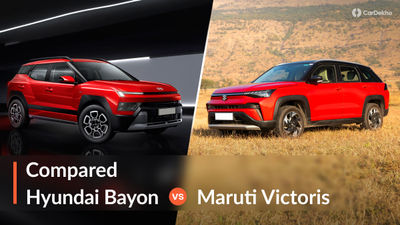
Hyundai Bayon Vs Maruti Victoris Compared: Which Vanilla Tastes Better? Korean Or Japanese
More tech and power from the Bayon versus more fuel options and a 5-star rating for the Victoris
| We are helping 50 of our lucky readers with a personalised car buying journey. You will be able to directly speak to an automotive expert and get all your doubts answered. Fill this form and if you are one of those lucky customers, we’ll get in touch with you soon. |
Hyundai recently decided to further spice up the competition in the compact SUV market with the launch of the Bayon at Rs 10 lakh (ex-showroom) onwards. The Bayon was introduced to sit between the Venue and the Creta in Hyundai’s SUV lineup, thus widening their flavours of SUVs under the Rs 20 lakh segment.
The Bayon is among the no-nonsense offerings from Hyundai, with a tried-and-tested powertrain and features. This makes it a good comparison against other no-nonsense SUVs in the class, prime among which is the Maruti Victoris. The Victoris may look larger in size and wear a more widely trusted badge. But which is better overall in dimensions, features, and powertrain? Let's take a deep dive and compare the Hyundai Bayon and the Maruti Victoris:
Price
| Model |
Hyundai Bayon |
Maruti Victoris |
| Price |
Rs 10 lakh to Rs 18 lakh |
Rs 10.45 lakh to Rs 19.99 lakh |
All prices are ex-showroom.
The Hyundai Bayon undercuts the Victoris’ starting price by Rs 45,000. The Bayon is also cheaper by Rs 1.99 lakh compared to the Victoris on the top end, which is mostly due to the hybrid powertrain available in the Victoris.
Dimensions
| Dimension |
Hyundai Bayon |
Maruti Victoris |
Difference |
| Length |
4245 mm |
4360 mm |
(- 115 mm) |
| Width |
1810 mm |
1795 mm |
+ 15 mm |
| Height |
1605 mm* |
1655 mm |
(- 50 mm) |
| Wheelbase |
2600 mm |
2600 mm |
0 mm |
*With roof rails
-
The Bayon, despite being a smaller-looking SUV, is wider than the Victoris by 15 mm.
-
However, the Victoris is larger than the Bayon in length and height by 115 mm and 50 mm, respectively.
-
Both share an identical 2600 mm wheelbase, so rear legroom on paper should be similar. While both aren’t the best in class for legroom, they are spacious enough for the average-sized family.
Explore More
Hyundai Bayon Vs Kia Seltos: A Head-to-Head Comparison Between Two Well-equipped Korean SUVsColour Options
| Hyundai Bayon |
Maruti Victoris |
| Atlas White* |
Arctic White |
| Ecotronic Grey |
Magma Grey |
| Golden Bronze |
Splendid Silver* |
| Titanium Black |
Bluish Black |
| Classy Blue |
Eternal Blue* |
| Fiery Red* |
Sizzling Red* |
| Titanium Black Matte |
Mystic Green |
| Classy Blue Matte |
- |
*Dual-tone options
-
The Bayon comes with six basic colour options, out of which there are two dual-tone colours: Fiery Red and Atlas White with a black roof.
-
Two matte-finish colour options include Titanium Black and Classy Blue.
-
Meanwhile, the Victoris has 7 basic colour options, out of which three are offered with dual-tone black roof colour options: Eternal Blue, Sizzling Red and Splendid Silver.
Features And Safety
| Feature |
Hyundai Bayon |
Maruti Victoris |
| LED Projector Headlamps |
✅ |
✅ |
| LED DRLs |
✅ |
✅ |
| LED Taillamps |
✅ |
✅ (Connected) |
| Wheels |
17-inch dual-tone alloy |
17-inch dual-tone alloy |
| Rear Spoiler |
✅ |
✅ |
| Sharkfin Antenna |
✅ |
✅ |
| Roof Rails |
✅ |
✅ |
| Panoramic Sunroof |
✅ |
✅ |
| Powered Tailgate |
❌ |
✅ (With gesture control) |
| Power-adjustable Driver Seat |
✅ (8-way) |
✅ (8-way) |
| Ventilated Seats |
✅ (Front only) |
✅ (Front only) |
| Rear Reclining Seat |
✅ (2-step) |
❌ |
| Ambient Lighting |
✅ (Blue) |
✅ (64 colours) |
| Infotainment System |
✅ (12.3-inch touchscreen) |
✅ (10.1-inch touchscreen) |
| Wireless Apple CarPlay/Android Auto |
✅ |
✅ |
| Digital driver’s display |
✅ (12.3-inch) |
✅ (10.25-inch) |
| Head-up Display |
❌ |
✅ |
| Cabin Air Purifier |
❌ |
✅ (PM 2.5 with display) |
| Wireless Phone Charger |
✅ |
✅ |
| Sound System |
8-speaker Bose |
8-speaker Infinity |
| Generative AI Voice Assistant |
✅ |
❌ |
| Auto-dimming IRVM |
✅ |
✅ |
| Automatic Climate Control |
✅ |
✅ |
| Rear AC Vents |
✅ |
✅ |
| Keyless Entry with Push-button Start/Stop |
✅ |
✅ |
| USB Charging Ports |
✅ (Type-C, front and rear) |
✅ (Type-C, front and rear) |
| Paddle Shifters |
✅ (CVT only) |
✅ (6-speed AT only) |
| Multi-drive Modes |
✅ (CVT only) |
✅ (Strong hybrid AWD only) |
| Connected Car Technology |
✅ |
✅ |
| Adaptive Cruise Control |
✅ |
✅ |
| Rear Wiper with Washer |
✅ |
✅ |
| Airbags |
6 |
6 |
| 360-degree Camera |
✅ |
✅ |
| Parking Sensors |
✅ (Front, Rear and Side) |
✅ (Front and Rear) |
| ESC (Electronic Stability Control) |
✅ |
✅ |
| Hill Hold Assist (HHA) |
✅ |
✅ |
| Electric parking brake (EPB) with auto hold |
✅ |
✅ (6-speed AT only) |
| Rear Disc Brakes |
✅ |
✅ |
| Tyre pressure monitoring system (TPMS) |
✅ |
✅ |
| Dashcam |
✅ |
❌ |
| Level-2 ADAS |
✅ |
✅ |
| Blind-spot Warning |
✅ |
✅ |
| Blind-spot View Monitor |
✅ |
❌ |
| Driver Attention Warning |
✅ |
❌ |
-
The two are closely matched, with the Bayon getting features like a reclining rear seat, a larger touchscreen infotainment, a dashcam and a blind-view monitor.
-
However, the Victoris gets features like a powered tailgate, a head-up display, a cabin air purifier, and customisable ambient lighting.
-
The two, however, are not far from each other in features and include a panoramic sunroof, a powered driver’s seat, a digital driver’s display, and automatic climate control.
-
Safety-wise, both include 6 airbags, Level-2 ADAS, blind-spot warning, a tyre-pressure monitoring system, a 360-degree camera and front and rear parking sensors.
-
The Victoris scored 5 stars in the BNCAP safety tests, while the Bayon has yet to be tested as of this story's publication.
Powertrain Options
| Model |
Hyundai Bayon |
Maruti Victoris |
||
| Engine |
1.5-litre naturally aspirated petrol |
1.5-litre naturally aspirated petrol with mild hybrid |
1.5-litre petrol + CNG |
1.5-litre petrol strong hybrid |
| Power |
115 PS |
103 PS |
88 PS |
92 PS (engine) + 80 PS (motor) |
| Torque |
144 Nm |
139 Nm |
121.5 Nm |
122 Nm (engine) + 141 Nm (motor) |
| Transmission |
6-speed MT / CVT |
5-speed MT / 6-speed AT |
5-speed MT |
e-CVT |
| Drivetrain |
2WD |
2WD / AWD |
2WD |
2WD |
| Claimed Mileage |
17.2 kmpl (MT) / 18.6 kmpl (CVT) | 21.18 kmpl (MT) / 21.06 kmpl (AT) / 19.07 kmpl (AllGrip AT) |
27.02 km/kg |
28.65 kmpl |
MT - Manual Transmission, AT - Automatic (torque converter), CVT - Continuously Variable Transmission
-
Both cars come with a well-refined 1.5-litre naturally aspirated engine each. However, the Bayon gets a 6-speed manual and a CVT automatic option, while the Victoris gets a 5-speed manual and a 6-speed Torque Converter automatic transmission option.
-
The Victoris also gets an underbody-mounted CNG powertrain option available only for the manual gearbox. However, Hyundai has confirmed the arrival of the Bayon CNG by January 2027.
-
The Victoris also gets a 1.5-litre petrol hybrid powertrain option, which is among the most fuel-efficient compact SUVs available in the segment. It is also the only one here to be offered with an AWD drivetrain option, available only with the 6-speed AT.
CarDekho Says…
The Hyundai Bayon sits in an interesting spot where the starting price in the segment is among the lowest in the class while also being slightly compact in dimensions. Despite its 4.2-metre length, the Bayon is reasonably comfortable and spacious for the average-sized family. Moreover, it is also far from compromised in the features department, like most Hyundais.
Meanwhile, the Victoris is also among the no-nonsense options in the segment with a good list of features, powertrain options and looks. For those looking for proven reliability and rugged use, the Victoris can be the better choice, also thanks to the AWD option.
Which is your favourite compact SUV? Let us know in the comments below.
Other Cars To Consider
-
Honda Elevate: The Elevate is among the handsome-looking SUVs with a robust naturally aspirated engine and a comfortable family-friendly cabin.
-
Hyundai Creta: The segment king is expectedly packed with features and ticks most boxes for many thanks to the vast powertrain options and features available.
-
Kia Seltos: The recent generation update makes it among the largest SUVs in the class, with great room and good road presence thanks to the mean styling and also gives a good sense of occasion in the cabin.
-
Renault Duster/ Nissan Tekton: The European twins are among the sporty SUVs here, with the Duster having the segment's best hybrid option. Packed with features and good drivability.
-
Tata Sierra: The largest SUV in the class also has retro-modern styling on its list of strengths. Being a Tata, it is also packed with features and also gets 3 engine options.
-
Maruti Grand Vitara/ Toyota Urban Cruiser Hyryder: These are also among the top no-nonsense SUVs, which also have AWD and Hybrid powertrain options. They do best for people who value the badges and their experience the most.
-
Volkswagen Taigun/ Skoda Kushaq: Among the sportiest-feeling SUVs which look compact but have respectable space inside. With the recent facelifts, they also have a few segment-first features like rear massaging seats (Kushaq).
-
Tata Curvv: The Curvv is for people who want something different. The shape can impress many for its distinctiveness and also keeps up the experience with the features once you get inside one.
-
MG Astor: This is among the oldest options in the segment. However, the Astor packs in premium interiors and decent drivability with a touch of European feel overall.
-
Citroen Aircross X: The Aircross offers among the best ride comfort in the class. It also packs a potent turbo-petrol engine with premium interiors and features.