
Hyundai Adds Assured Buyback Cover To The Creta Electric, Betting On Confidence Over Just Range
The promise of 60% value could help the Creta Electric's value case further.


- Write a comment
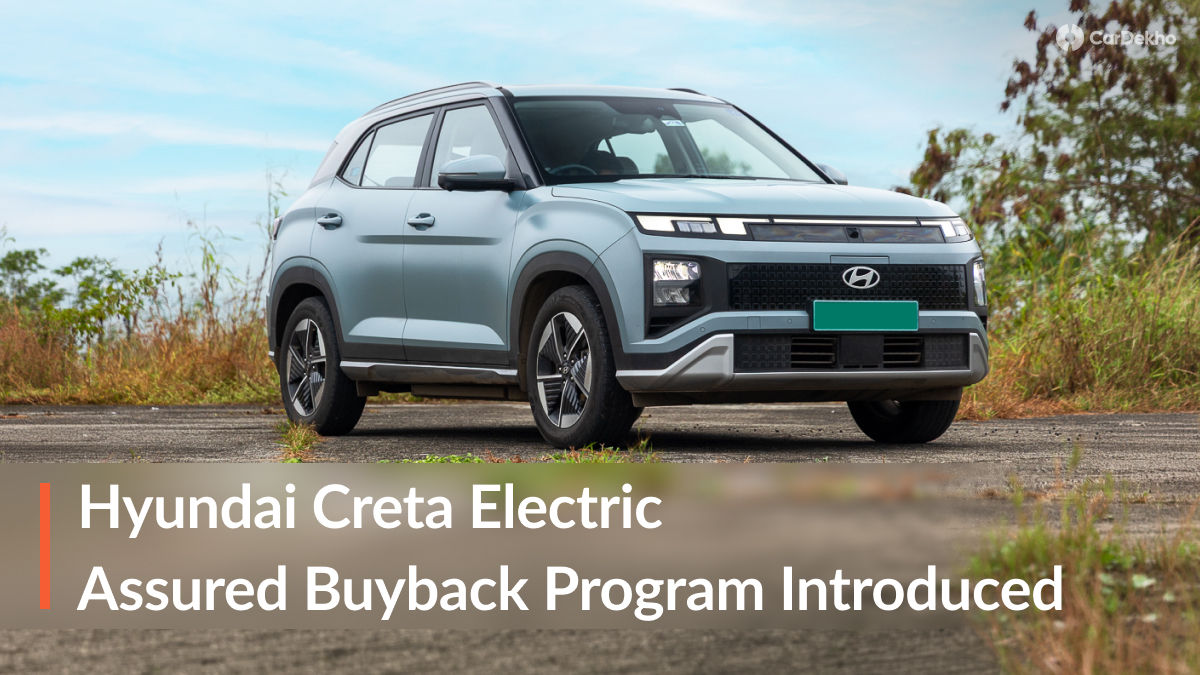
Owning a Creta Electric just got a financial safety net. Hyundai Motor India has rolled out an Assured Buyback Program for the already-on-sale Creta Electric, promising to repurchase the car at 60% of its ex-showroom value, provided it's returned within three years or before it crosses 45,000 km, whichever happens first. It's not a new car launch so much as a new layer of reassurance bolted onto an existing one, and that distinction matters. Resale anxiety has long been the quiet dealbreaker for EV shoppers in India, and Hyundai is now addressing it head-on rather than leaving it to chance.
What's Actually New Here
The headline addition is that buyback guarantee of 60% of the original ex-showroom price back, no drama, as long as owners stay within the time and mileage limits. It's Hyundai's answer to a question every EV buyer eventually asks: what happens when I want out?
Then there's Battery-as-a-Service, which technically isn't brand new but continues to anchor Hyundai's affordability push. Skip buying the battery outright and the Creta Electric's price drops to Rs 10.99 lakh; instead, you pay for battery use as you go, with EMI starting from Rs 3.9 per km on the 42kWh pack (that number is based on 90% battery financing at 8.75% interest, spread over eight years). It's a genuinely different way to think about EV ownership costs, less "buy it all at once," more "pay as it moves."
Charging support hasn't been ignored either. Hyundai currently runs 183 DC fast chargers spread across 105 cities, and the myHyundai app opens up access to more than 30,000 charging points nationwide. The company's already committed to scaling that fast-charger count to 600 by 2030. A number that, if hit, would meaningfully close the infrastructure gap that still worries a lot of first-time EV buyers.
The Numbers, For Reference
Nothing changes here; the Creta Electric still comes in two flavours. Standard Range runs a 42kWh battery good for an ARAI-rated 420 km, while Long Range steps up to 51.4kWh and stretches that to 510 km. Both charge from 10 to 80% in a claimed 39 minutes on DC fast charging. Worth noting: Hyundai's own testing clocks Creta Electric at 0-100 km/h in 7.9 seconds, and both trims come with extras like Vehicle-to-Load (V2L) reverse charging support, a digital key, and Level-2 ADAS features. Small things that round out the ownership picture beyond just range and price.
Battery and drivetrain specifications are as follows:
| Specification |
Standard Range |
Long Range |
| Battery Capacity |
42 kWh |
51.4 kWh |
| Claimed Range (MIDC part 1 + part 2) |
420 km |
510 km |
| Power |
135 PS |
171 PS |
| Torque |
200 Nm |
200 Nm |
| DC Fast Charging (10-80%) |
39 minutes |
39 minutes |
Price And Rivals
Pricing for the Creta Electric continues to span Rs 18.03 lakh to Rs 23.67 lakh (ex-showroom), putting it right in a segment that's only getting more crowded by the month. The BaaS route undercuts that considerably at Rs 10.99 lakh upfront, before factoring in per-km battery costs, arguably its sharpest weapon against rivals asking for more money at the point of purchase.
Speaking of rivals, the Creta Electric goes against the likes of the MG ZS EV, Tata Sierra EV and Curvv EV, MG Windsor EV, Vinfast VF 6 and VF 7, Maruti Suzuki e Vitara, Toyota Ebella and Mahindra's BE 6. Specs alone won't decide this one. Ownership terms increasingly will.
CarDekho Says…
Here's the thing about EV hesitancy in India. It was never really about range anxiety alone. It's what happens three years down the line, when the battery's aged and the resale market hasn't quite figured out what a used EV is worth. Hyundai's buyback program goes straight after that uncertainty, and pairing it with BaaS covers both ends of the ownership timeline: what you pay going in, and what you get coming out.
Two kinds of buyers stand to gain the most from this. City drivers chasing lower upfront costs will likely lean toward the 42kWh model under BaaS. It keeps the entry price down while comfortably covering daily driving needs. Families wanting one car that handles both errands and highway runs are probably better off with the 51.4kWh Long Range bought outright, where the 510 km range does the heavy lifting and the buyback guarantee quietly removes a chunk of the financial risk.
Whether this becomes the industry norm or stays a Hyundai differentiator remains to be seen. But it's a fair bet that other automakers will be watching how buyers respond. Because if resale certainty turns out to be the thing that finally moves fence-sitters into EVs, everyone's going to want a version of this program. What do you make of Hyundai's buyback push for the Creta Electric? Let us know in the comments.