

Your Next Car Could Brake On Its Own: Government Proposes Mandatory AEB From 2030!
The Road Ministry wants every new car in India to brake for you in case of an emergency. Here's what the draft means, and what it doesn't tell you yet.
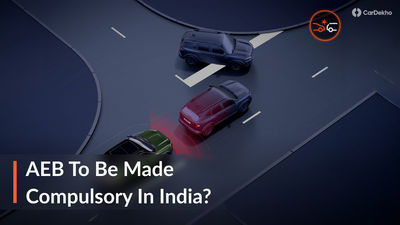
We've all had that moment. You glance at your phone, look up, and the car ahead has stopped dead. Now imagine your car spotting it first, beeping at you, and braking on its own before you even react. That's Automatic Emergency Braking, or AEB.
The Ministry of Road Transport and Highways (MoRTH) wants it fitted as standard on every passenger car sold in India, starting with all-new models from October 2030 and later covering every car on sale from October 2032. The same draft also brings safety rules for introducing lane-keeping, drowsiness alerts, ISOFIX child seat mounts and even luggage in your boot. Here's what it all means for you, in plain words.
What Does the Draft Propose?
Apart from AEB, there are a few more safety features that the draft proposes, which are as follows:
-
Steering effort (AIS-193), from October 2027: Every car, SUV, bus and truck would need steering that meets a set standard for how much effort it takes to turn the wheel. It's a basic safety check that ensures you can steer in an emergency. So this likely implies that all vehicles sold will come with a power steering system.
-
Automatic steering, a.k.a. ACSF (AIS-193): These are features where the car steers itself, such as lane-centring. From October 2027, any car that offers them must meet the standard. From October 2029, they become compulsory for taxis and other transport-registered cars.
-
Emergency Lane Keeping a.k.a. ELKS (AIS-191 Part 1): This system steers you back if you drift out of your lane unintentionally. In more common terms, this is called Lane Keeping Assist. The same pattern applies: it must meet the standard from October 2027 if offered, and becomes compulsory for taxis from October 2029.
-
Driver drowsiness and attention warning (AIS-184): This feature watches for signs that you're tired or distracted and alerts you to take a break. Again, the standard applies from October 2027 if offered, and the feature becomes compulsory for taxis from October 2029.
-
Child-seat mounts (AIS-182): Cars with ISOFIX anchors, top-tether points or i-Size seating positions would have to meet a common standard. That applies from October 2027 for new models and October 2028 for all models. The draft doesn't make ISOFIX compulsory; it sets the regulation for cars that have it.
-
Luggage retention (IS 15546:2005): All cars would need to meet a standard that stops bags in the boot from flying into the cabin in a crash. This one is not optional: it applies from April 2028 for new models and October 2028 for all models.
The Proposed Timeline
AEB may grab the headlines, but it's the last step in a five-year rollout. The draft works in three stages.
From October 2027, safety features that carmakers already offer, like lane-keeping and drowsiness alerts, would have to meet proper Indian standards.
From October 2029, taxis would be required to have some of these features. Then, from October 2030, AEB itself would start becoming compulsory, beginning with new models.
Here's the full schedule:
| Proposed date |
What changes |
Applies to |
| October 1, 2027 |
Steering effort must meet AIS-193; cars offering automatic steering (ACSF) must meet AIS-193, and cars with Emergency Lane Keeping (ELKS) must meet AIS-191 (Part 1) |
All motor vehicles (steering); M1 cars that offer ACSF or ELKS |
| October 1, 2028 |
Cars that already offer AEB must pass India's AEB standard, AIS-185 |
M1 cars and N1 goods vehicles (up to 3.5 tonnes) |
| October 1, 2029 |
ACSF and ELKS become compulsory |
M1 cars registered as transport vehicles, such as taxis |
| October 1, 2030 |
AEB compulsory on all new models |
M1 cars |
| October 1, 2032 |
AEB compulsory on all models, including older ones |
M1 cars |
M1 means passenger cars with up to eight seats plus the driver; N1 means light goods vehicles up to 3.5 tonnes. In the draft, 2028 is only the testing standard for cars that already offer AEB.
Explore More
Top 10 Most Affordable Cars With Ambient Lighting: Premium Interior Feel Is Available In Small Car BudgetWhat Is AEB?
AEB stands for Automatic Emergency Braking. This tech uses a camera, a radar or both to watch the road ahead. If a crash looks likely, it warns you first; if you still don't react, it brakes on its own to avoid the crash or soften the impact.
It is one ADAS feature, not the full suite: the draft does not make adaptive cruise or lane-keep assist compulsory for private cars.
What Does AEB Do?
Under India's AEB standard, AIS-185, the car must completely avoid hitting a stopped car at up to 40 kmph, and a child-sized pedestrian dummy crossing the road at up to 30 kmph.
Between those speeds and 60 kmph, it only has to reduce the impact speed. It must warn you in at least two ways (a sound, a vibration or a visual alert) before braking. You can override it by steering or flooring the accelerator, and it can't be switched off above 10 kmph. If you do turn it off, it switches back on every time you restart the car.
What Does All Of This Mean For You?
If you're buying a car now, there's no reason to wait. None of this is law yet, and the draft doesn't ask existing owners to retrofit anything. If it goes through as is, all-new models launched from October 2030 would get AEB as standard, while older models still on sale would have until October 2032.
Expect entry-level cars to get costlier, since most of them don't offer AEB today, though the draft gives no cost estimate. The upside is quality: from 2028, any cars with AEB on sale would have to pass set tests, so it won't just be a feature on the spec sheet.
Families also benefit: child-seat mounts and luggage retention get proper standards by 2028.
If you drive a taxi or buy a car for commercial use, the change comes sooner. From October 2029, transport-registered cars would need lane-keeping, steering assist and drowsiness alerts.
What The Draft Doesn’t Answer, And Leaves Ambiguous?
The biggest gap is bikes and cyclists. AIS-185 tests AEB only against cars and pedestrians; the cyclist part is reserved for later, and two-wheelers aren't covered as a separate case. On Indian roads, that's a serious miss.
Speed is the other limit: the standard requires AEB to work only between 10 and 60 kmph for cars ahead (20 to 60 kmph for pedestrians), and all tests run in daylight. That makes it a city-speed safety net, not highway protection, with no night-time pedestrian test.
There's more fine print to settle. It's unclear whether a facelift or a new variant counts as a "new model" under the 2030 deadline. Indian traffic, with cattle, unmarked speed breakers and vehicles cutting in, can also trigger false or missed braking, so real-world tuning will matter. And small pickups and other N1 goods vehicles (up to 3.5 tonnes) only need to meet AIS-185 if they offer AEB; they aren't required to have it.
Remember, It’s Still A Draft
None of this is final yet. The ministry published the draft in the Gazette on October 21, 2026, and is taking public feedback for 30 days. After that, it can approve the rules, change them or drop them altogether.
Want to have your say? You can email your suggestions to comments-morth@gov.in before the window closes.
CarDekho Says…
On paper, mandatory AEB is a welcome step, and the push to make safety tech actually meet proper standards is overdue. But on Indian roads, good intentions alone won't be enough.
The first worry is everyday usability. Under the proposed standard, AEB switches itself back on every time you start the car, even if you turned it off on your last drive. The bigger concern is how drivers and the system will cope with each other. Most Indian drivers have never used AEB, and a car that suddenly brakes on its own can catch them off guard, for them and the vehicle behind as well.
Indian roads are interesting, where a surprise waits every minute, at every turn, on every kilometre. A cow that has the right of way by tradition. A scooter that appears from a gap that didn't exist a second ago.
A system raised on orderly European traffic may either slam the brakes at a plastic bag or politely ignore the bike cutting across your bonnet. And the driver behind you, sitting a respectful two inches off your bumper, won't be expecting your car to stop for a shadow. The feature designed to prevent crashes might just end up starting a few.
The idea is right; the homework isn't done yet. Before AEB becomes compulsory, it needs to be tested against two-wheelers, chaos and real Indian traffic, not just a polite dummy on a dry track. Drivers also need to know what their car is about to do. Until then, if you want AEB, take a long test drive in rush-hour traffic first. If it survives your daily commute without a nervous breakdown, it's a keeper.
What do you think about the proposed changes? Let us know in the comments!