

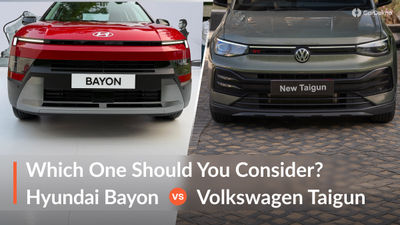
Hyundai Bayon vs Volkswagen Taigun: Which SUV Suits Your Needs More?
While the Bayon is an all-rounder, the Taigun is for those who want maximum driving thrillsThe Hyundai Bayon one ups the Volkswagen Taigun by offering ADAS (Level-2)
|
We are helping 50 of our lucky readers with a personalised car buying journey. You will be able to directly speak to an automotive expert and get all your doubts answered. Fill this form and if you are one of those lucky customers, we’ll get in touch with you soon. |
There is no-doubt that with the launch of the new Bayon, Hyundai has left a strong first impression on buyers and even its competitors. With a tried and tested engine as well as a few features shared with Creta, the new Hyundai makes you think twice before spending money on any of its competitors.
But what happens when we compare the new kid on the block with an European SUV, the Volkswagen Taigun? Does the Hyundai Bayon pack enough punch to become a better choice than the Taigun?
To help you answer this question, we’ve compared these two SUVs, and will help you understand which SUV makes sense for you.
Price
| Model |
Hyundai Bayon |
Volkswagen Taigun |
| Price (ex-showroom) |
Rs 10 lakh to Rs 18.15 lakh |
Rs 11 lakh to Rs 19.47 lakh |
- The Hyundai Bayon is Rs 1 lakh cheaper from the base variant, making it great value for money if your budget is capped at that price point.
-
The top-spec Volkswagen Taigun is much more expensive than the top of the line Hyundai Bayon. But when taking into consideration the huge power difference between the two, it ends up being a great action, if you’re looking to buy from a driver’s perspective.
-
In the price department, the Hyundai Bayon is more affordable and offers a good amount of features for its price.
Dimensions
| Dimensions |
Hyundai Bayon |
Volkswagen Taigun |
Difference |
| Length |
4,245 mm |
4,221 mm |
+24 mm |
| Width |
1,810 mm |
1,760 mm |
+50 mm |
| Height |
1,605 mm |
1,612 mm |
-7 mm |
| Wheelbase |
2,600 mm |
2,651 mm |
-51 mm |
| Ground Clearance |
205 mm |
188 mm |
+17mm |
- With a slightly bigger length and noticeable difference in width, the Hyundai Bayon is a bigger car than the Volkswagen Taigun.
-
However, the Taigun is slightly taller and has a much longer wheelbase as well.
-
The Hyundai Bayon gets slightly taller ground clearance when compared to the Volkswagen Taigun.
Explore More
2026 Hyundai Bayon Fuel Economy Figures Revealed, Check Out Which Gearbox Option Offers Better Mileage?Colour Options
| Hyundai Bayon |
Volkswagen Taigun |
| Atlas White* |
Avocado Pearl |
| Fiery Red* |
Wild Cherry Red* |
| Ecotronic Grey |
Candy White* |
| Golden Bronze |
Deep Black Pearl |
| Titanium Black |
Steel Grey |
| Titanium Black Matte |
Lava Blue |
| Classy Blue |
Reflex Silver* |
| Classy Blue Matte |
Carbon Steel |
| Carbon Steel Matte |
-
When it comes to simply the number of color options, the Volkswagen Taigun is the clear winner. The German SUV gets 9 color options, whilst the South Korean SUV only gets 8 color options
-
Both the cars do offer dual-tone colors, but the Taigun offers you more choice with 3 dual-tone hues, whereas the Bayon only offers 2.
-
Both the cars also come in matte colors, but Hyundai Bayon offers 2 matte color options, whereas the Volkswagen Taigun only comes in 1.
Features
| Features |
Hyundai Bayon |
Volkswagen Taigun |
| LED Headlamps |
✅ (Projector) |
✅ (Projector) |
| LED DRLs |
✅ |
✅ |
| Fog lamps |
❌ |
✅ (Rear only) |
| Alloy Wheels |
✅ |
✅ |
| ORVMs with LED Indicators |
✅ |
✅ |
| Chrome door handles |
❌ |
✅ |
| Sharkfin antenna |
✅ |
✅ |
| Chrome windowline accents |
❌ |
✅ |
| LED Taillamps |
✅ |
✅ |
| Rear Illuminated Logo |
❌ |
✅ |
| Roof spoiler |
✅ |
✅ |
| Leatherette seat upholstery |
✅ |
✅ |
| Power-adjustable front seats |
✅ (8-way driver only) |
✅ (6-way for driver and 6-way for front passenger) |
| Rear AC vents |
✅ |
✅ |
| Ambient lighting |
✅ (Single Color) |
✅ (Single Color) |
| 60:40 split-folding rear seat |
✅ |
✅ |
| Auto-dimming IRVM |
✅ |
✅ |
| Sunroof |
✅ (Panaromic) |
✅ (Panaromic) |
| Touchscreen infotainment system |
✅ (12.3-inch) |
✅ (10.1-inch) |
| AI Integration |
✅ (Generative AI) |
✅ (Google Voice Assitance) |
| Wireless Android Auto and Apple CarPlay |
✅ |
✅ |
| Cruise control |
✅ |
✅ |
| Automatic Climate Control |
✅ |
✅ |
| Digital Driver’s Display |
✅ (12.3-inch) |
✅ (10.25-inch) |
| Ventilated front seats |
✅ |
✅ |
| Wireless phone charger |
✅ |
✅ |
| Sound system |
✅ (8-speaker Bose with subwoofer) |
✅ (6-speaker) |
| Connected car technology |
✅ |
✅ |
| Drive modes |
✅ |
❌ |
| ADAS (advanced driver assistance systems) |
✅ (Level-2) |
❌ |
| 6 airbags |
✅ |
✅ |
| Electronic stability control (ESC) |
✅ |
✅ |
| Hill hold assist (HHA) |
✅ |
✅ |
| Parking Sensors |
✅(Front Rear) |
✅(Front Rear) |
| Parking Camera |
✅(360-degree) |
✅ |
| Dashcam |
✅ |
❌ |
| ISOFIX child seat anchors |
✅ |
✅ |
- When it comes to the basic features like LED lights, leatherette upholstery seats, ambient lighting and rear AC vents, both the Bayon and Taigun are covered on that end.
-
Convenience features like ventilated front seats, automatic climate control, wireless charger are covered by both the cars. Both cars come with panoramic sunroof, with their lower variants getting a single-pane sunroof.
-
The Hyundai Bayon comes with an 8-way power adjustable driver’s seat, while both the front seats in the Volkswagen are power adjustable.
-
The Hyundai Bayon gets bigger screens for the touchscreen and digital driver’s display.
-
If jamming music is your thing, then Hyundai Bayon’s 8-speaker system from Bose is the clear winner, over Volkswagen Taigun’s 6-speaker system.
-
Whilst both the cars cover the essential safety features like 6 airbags, ISOFIX child safety mounts, ESC, front and rear parking sensors. The Taigun, however, misses out on offering Level 2-ADAS and 360-degree parking camera.
Powertrain
| Specifications |
Hyundai Bayon |
Volkswagen Taigun |
|
| Engine |
1.5-litre naturally aspirated petrol |
1-litre turbocharged petrol TSI |
1.5-litre turbocharged petrol |
| Number of Cylinders |
4 |
3 |
4 |
| Power |
115 PS |
115 PS |
150 PS |
| Torque |
144 Nm |
178 Nm |
250 Nm |
| Transmission |
6-speed MT, CVT |
6-speed MT, 8-speed AT |
7-speed DCT |
- Despite Bayon’s 1.5 litre engine and Taigun’s 1 litre engine producing similar power, Bayon lacks behind the Taigun in terms of torque. However, the Bayon comes with a 4-cylinder naturally aspirated engine, compared to Taigun’s 3 cylinder turbo-petrol engine.
-
The Volkswagen Taigun is the clear winner in this department, as it also comes with a 1.5 turbo-petrol engine, producing 150 PS and 250 Nm. Easily a superior option, if power and driving thrills matters to you.
-
The Hyundai Bayon CVT caters to buyers who do daily commuting in bumper-to-bumper traffic.
-
The Volkswagen Taigun’s 7-speed DSG caters to buyers who seek a more crisp and quicker shift response from their gearbox.
-
The Volkswagen Taigun ultimately offers more engine options, when compared to the Hyundai Bayon.
CarDekho Says…
There is no doubt that both the cars are outstanding in their own ways. Ultimately, the Hyundai Bayon and the Volkswagen Taigun cater to a different type of buyers.
The Hyundai Bayon suits a type of buyer who prefers a car which is comfortable to sit into, feature loaded, gets good technology and is easy to drive and live with. The Volkswagen Taigun on the other hand suits a kind of buyer who is a driving enthusiast, who loves quick and crisp gearshifts, and prefers a rather sophisticated design language that you get from European vehicles.
If you’re interested in knowing more about how the Bayon fares with other cars from this segment, here are some options.
Hyundai Creta: Arguably the king of this segment, offers more convenience features and multiple engine options. Read this article to see what the Creta gets over the Bayon.
Kia Seltos: Recently updated, the Seltos is one of the largest cars in its segment and is loaded with tech and features. Read this article to see what the Seltos gets over the Bayon.
Tata Sierra: The Tata Sierra is a great looking car that packs in great safety, tech, features, along with great road presence. But do consider Tata’s aftersales service in mind.
Maruti Grand Vitara/Toyota Hyryder: If reliability and ease of ownership is what you seek, then go with the Grand Vitara/Hyryder. Essentially the same cars that also come with fuel-efficient strong hybrids, both differ in minor design tweaks and few features.
Maruti Victoris: Packs in a sleek design and comes with strong hybrid tech for those who want great fuel efficiency. Read this article to see what the Victoris gets over the Bayon.
Honda Elevate: This is your go-to option if you seek a good balance between sophistication, good features, reliability and a clean design. The lack of engine options is one of Elevate’s downside.
Tata Curvv: If you’re a fan of the SUV-coupe style design, and want to stand out from the other SUVs, then Tata Curvv will be a great fit for you!
Skoda Kushaq: Same package as the Volkswagen Taigun, but with more elegant styling and rear-seat massagers. Bayon vs Kushaq compared here.
Renault Duster/Nissan Tekton: Both the Duster and Tekton are a great value for money cars that deliver on driving thrills. If you’re looking for a car with a rugged design, then the Duster is your choice. Whereas if you’re looking for an SUV with rather classy styling, then Tekton is your way to go.
MG Astor: Arguably one of the best interiors in this segment, the Astor is for those who care more about an upmarket cabin, loaded with features.