
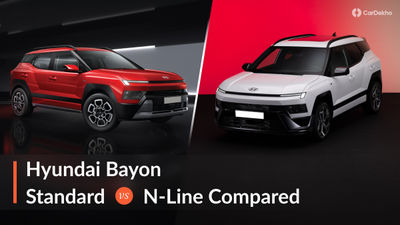
Hyundai Bayon Standard vs Bayon N Line Compared: What Are The Differences?
The Hyundai Bayon N Line that was revealed at the Paris Motor Show 2026 gets more kit and sportier styling
Hyundai India recently took wraps off its next SUV, the Bayon for the Indian market. However, the carmaker’s European division also revealed the N Line version of the Bayon at the Paris Motor Show shortly afterwards.
While both crossovers are similar, the N Line gets sportier styling, more kit and completely different powertrain options when compared to the standard model that will be sold here. In this story, we compare the two and see what is the same, and what has changed. Do note that a standard version of the Hyundai Bayon is also expected to be available in Europe.
Design
Starting from the styling, there is a remarkable similarity between how both the cars look, despite having different underpinnings. Up front, the India-spec Bayon gets a sleek look with inverted ‘L-shaped’ DRLs, large rectangular LED headlamps on the bottom and a generous amount of cladding on the bumper. The N Line car offers a familiar look for its fascia, but being the N-Line variant, gets an aggressive and sportier bumper to give it a sleek look.
In profile too, both cars get a chunky and sculpted look. You also have thick wheel arch cladding, black roof rails, a sharkfin antenna and pull-type door handles as common elements, although the standard Bayon gets smaller 17-inch alloy wheels, compared to the N Line’s 18-inch units.
Move on to the rear end, and both versions look sleek and sharp. Here, commonalities include slim inverted ‘L-shaped’ taillamps, a roof spoiler and generous amount of cladding on the bumper. The Bayon N Line further makes things sportier with an aggressive two-part roof spoiler, dual-tip exhaust and a diffuser on the bumper instead of the silver skid plate present on the Indian car.Head on to this story for a closer look at the standard Bayon that will be sold in India.
| Note: The EU-spec Bayon was revealed in the sportier ‘N-Line’ avatar, which will not be available at launch with the Indian version. Regular variants may have differences in styling. |
Interior
Inside as well, both cars look similar, but there are some ‘N-Line’ specific touches and equipment that the standard car misses out on. The dashboard design remains common between both versions, with a curved dual-screen setup for the digital driver’s display and touchscreen infotainment system.
You also get some quirkiness in the form of circular door handles and speakers and the slim vertical AC vents placed in the middle with the climate controls sandwiched in-between.
When it comes to differences, the India-spec car gets a dual-tone white and black cabin theme and the four-spoke steering wheel with the ‘morse-code’ Hyundai logo, but the European version features an all-black theme with contrast red accents and the sportier ‘N-Line’ steering wheel and gear knob.
Features
You will start to truly realise the difference between both cars when you take a look at the features on offer. For India, Hyundai will offer tech such as a 12.3-inch touchscreen infotainment system, 12.3-inch digital driver’s display, single-zone automatic climate control, wireless Android Auto and Apple CarPlay, ventilated front seats, drive modes, a Bose premium sound system, Generative AI and a wireless phone charger. For more details on the India-spec Bayon’s feature list, check out this story.
In addition to these, the N Line car sold abroad also gets upgrades such as dual-zone climate control, heated front seats, panoramic sunroof, ambient lighting and a heated steering wheel too.
Safety
With the Bayon, Hyundai has kept safety as a focus for both markets. Both the Indian, and European versions will get tech such as Level 2 ADAS (Advanced Driver Assistance Systems), multiple airbags, 360-degree camera, front and rear parking sensors, electronic parking brake with auto-hold (EPB) and a blind-view monitor.
Features such as electronic stability control (ESC), hill-hold assist (HHA), tyre pressure monitoring system (TPMS) and ISOFIX child seat mounts are also expected to be on offer. It should come with 6 airbags as well.
Powertrains
Under the hood, both cars differ in their powertrain choices. The Bayon sold in India will be offered with a sole 1.5-litre naturally aspirated petrol engine from the Creta, while the European specification will get a choice of a 1-litre turbo-petrol engine and even a 1.6-litre turbo-petrol strong-hybrid setup at a later date. Here are their specifications:
| Model |
Hyundai Bayon (India-spec) |
Hyundai Bayon N Line (EU-spec) |
|
| Engine |
1.5-litre naturally aspirated petrol |
1-litre turbo-petrol |
1.6-litre turbo-petrol with strong-hybrid |
| Power |
115 PS |
90 PS/115 PS |
138 PS |
| Torque |
144 Nm |
172 Nm/TBA |
265 Nm |
| Transmission |
6-speed MT/CVT |
6-speed MT/7-speed DCT |
6-speed DCT |
| Drivetrain |
FWD |
FWD |
FWD |
MT- Manual Transmission, CVT- Continuously Variable Transmission (automatic), DCT- Dual Clutch Transmission (automatic), FWD- Front-wheel drive, TBA- To Be Announced
India-spec Bayon: Launch Date, Expected Price Rivals
Hyundai will launch the new Bayon in India on October 26. It is expected to be priced between Rs 10 lakh and Rs 17.5 lakh (ex-showroom). The Bayon will go on to rival compact SUVs like the Kia Seltos, Renault Duster, Skoda Kushaq, Volkswagen Taigun, Maruti Victoris and Grand Vitara, Toyota Urban Cruiser Hyryder, Nissan Tekton, Tata Sierra, Citroen Aircross X, Honda Elevate, MG Astor and its own sibling, the Hyundai Creta.
CarDekho Says…
Given various factors like buyer preferences, regulatory requirements and market competition, it is no surprise that there are some significant differences between the Bayon sold in India, and its N Line counterpart retailing in Europe. For starters, the European-spec car gets a sportier N-Line variant geared towards enthusiasts, a more premium interior and a wider powertrain choice too.
However, what is also worth mentioning here is that the Indian-spec Bayon may turn out to be quite a lot more affordable too, considering the fierce competition and cost benefits that come with producing it in India rather than Europe. As we near the launch, we eagerly await its pricing and the Bayon seems to be all set to shake up the compact SUVs segment once again. It also remains to be seen if Hyundai plans to offer a N Line version of the Bayon in India at a later date.
What do you think of the new Bayon? Comment down below!