

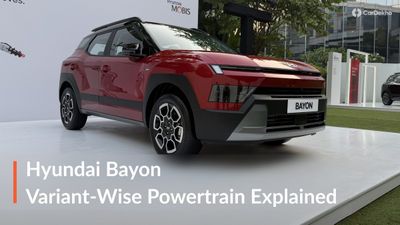
Hyundai Bayon Powertrain Options Detailed: Which Variant Gets Which Gearbox Option?
The Bayon gets just one engine, but you can pick between a manual and a CVT automatic!
Hyundai’s newest SUV, the Bayon, has been launched today and choosing a powertrain for it is refreshingly simple. Unlike the Creta’s three engines, the Bayon gets just one: a 1.5-litre naturally aspirated petrol, paired with a 6-speed manual or an CVT automatic. It will be offered across 7 variants: HX2, HX3, HX3 Plus, HX5, HX6, HX8 and HX10.
Here’s a look at which variant gets which gearbox.
Hyundai Bayon: Powertrain Specification
The Bayon uses a 1.5-litre four-cylinder petrol engine, a unit Hyundai says has sold over 6 lakh units in India since 2020. Hyundai has not offered a turbo-petrol, diesel or CNG option on the Bayon so far. Here are its detailed specifications:
| Engine |
1.5-litre naturally aspirated petrol |
| Power |
115 PS |
| Torque |
144 Nm |
| Transmission |
6-speed MT, CVT* |
| Claimed Fuel Efficiency |
18.6 kmpl (CVT) |
*CVT – Continuously Variable Transmission
The CVT gets a few performance-focused tricks. A Dash Boost mode delivers more power when you press the accelerator quickly while overtaking. A sporty drive tech function simulates gear shifts under hard acceleration. You also get three drive modes (Eco, Normal and Sport) and paddle shifters.
Hyundai Bayon: Variant-wise Powertrain Availability
The exact variant-wise powertrain allocation will be confirmed at launch, but we can confirm that it will come with manual and CVT gearbox options.
| Variant |
Petrol |
|
| MT |
CVT |
|
| HX2 |
✅ |
❌ |
| HX3 |
✅ |
❌ |
| HX3 Plus |
✅ |
❌ |
| HX5 |
✅ |
✅ |
| HX6 |
✅ |
✅ |
| HX8 |
✅ |
✅ |
| HX10 |
✅ |
✅ |
The manual gearbox could appeal to buyers who prefer greater control over gear changes, while the CVT automatic is likely to be the more convenient option for urban driving.
Explore More
2026 Hyundai Bayon Vs Hyundai Creta Compared: How Much More Does The Creta Offer Over The Bayon?Hyundai Bayon: Features And Safety
Features include dual 12.3-inch curved displays (touchscreen and digital driver’s display, wireless Android Auto and Apple CarPlay, a wireless phone charger, an 8-speaker Bose sound system, a panoramic sunroof, ventilated front seats, an 8-way powered driver’s seat, automatic climate control, rear AC vents, Hyundai Bluelink with over 70 connected car features, and over-the-air updates for up to 19 vehicle controllers.
The Bayon’s biggest highlight is Hyundai’s first generative AI voice assistant in India. It is powered by Perplexity and SoundHound AI, and can answer natural questions like planning a road trip or suggesting restaurants. It works only in English, but over 500 offline voice commands are also available in Hindi, Hinglish, Tamil, Bengali and Telugu. For more details on its feature list, check out our launch story.
Safety-wise, it gets six airbags as standard, ESC, hill-start assist, ISOFIX child seat mounts and three-point seatbelts for all seats. Higher variants add a 360-degree camera, front and rear parking sensors, a blind-spot view monitor, a dashcam and TPMS. They also get Level-2 ADAS, which Hyundai calls “Level 2 Pro”, including Highway Driving Assist on mapped expressways. Hyundai says the Bayon is engineered for 5-star Indian safety standards, but it has not been crash-tested yet.
Price And Rivals
The Hyundai Bayon is priced from Rs 10 lakh. Bookings are open for Rs 11,000. It will rival the Kia Seltos, Maruti Grand Vitara, Maruti Victoris, Toyota Hyryder, Honda Elevate, Skoda Kushaq and Volkswagen Taigun, as well as Hyundai’s own Creta.
You can also checkout this story for a closer look at the Bayon.
CarDekho Says..
With a single engine, picking a Bayon variant is simpler than picking a Creta. The 1.5-litre petrol is a proven unit and should feel smooth and easy to drive in the city, especially with the CVT. It is also good to see Hyundai offer the automatic gearbox right from the mid-spec HX5 variant, with the manual option available even for the top-end HX10 which will certainly give buyers a lot more flexibility in their choice. What’s missing is a turbo-petrol for enthusiasts and a CNG or hybrid option for buyers chasing efficiency. Rivals like the Grand Vitara and Victoris offer these. Instead, the Bayon’s case rests on its tech, led by the generative AI voice assistant and dual 12.3-inch screens.
Would you pick the Bayon’s CVT or stick with the manual? Let us know in the comments below.