
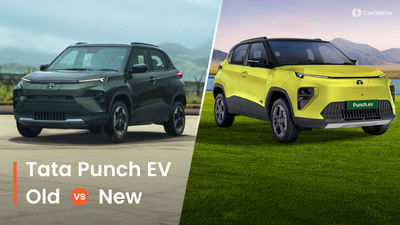
2026 Tata Punch EV Facelift Vs Pre-Facelift: What’s New And What’s Not?
Tata has not only updated the design, but also made some impactful changes in the powertrain department
Tata has launched the updated version of its most affordable electric SUV, the Tata Punch EV. While the overall design remains familiar, the facelift brings minor cosmetic tweaks, some new features, and most importantly, updated battery packs with improved range figures.
If you want to know what has changed with the new facelifted 2026 Punch EV, here’s a detailed comparison:
Exterior
At first glance, the facelifted Punch EV looks quite similar to the outgoing model, but there are subtle differences that stand out.
-
Up front, the connected LED light bar seen earlier has been removed. Instead, the facelift features LED DRLs positioned at the edges, giving it a cleaner appearance.
-
The bumper has been redesigned with a larger air dam and a textured silver faux skid plate, replacing the earlier black strip element.
-
Positioning of the charger remains the same, and it looks cleaner and more minimalist than the pre-faclift model.
-
From the side, the silhouette remains unchanged. You still get blacked-out ORVMs with integrated turn indicators, roof rails, thick body cladding, and 16-inch alloy wheels (same design as before).
-
The ‘Tata.ev’ badge on the lower front doors continues as before.
-
The biggest visual update is at the rear. The facelift now gets a connected LED tail-lamp setup similar to the ICE-powered Punch, along with a revised bumper design.
To sum it up, the design changes are not substantial but rather subtle and impactful. Especially bits like the updated fascia and connected taillights at the rear make the Punch EV look more contemporary than before. Over the pre-facelift model, the facelift model also brings a few new hues to the colour palette of the Punch EV.
| More ground clearance: Dimensionally, the Punch EV remains almost identical, though ground clearance has increased slightly to 195 mm (around 5 mm higher than before). |
Interior
Step inside, and the layout feels very familiar, almost mirroring the cabin theme of the pre-facelift model.
-
Like the outgoing model, you get a dual-tone cabin theme, and the free-floating 10.25-inch infotainment system takes centre stage.
-
However, there is a change in the dual-tone scheme. You now get a grey and white theme instead of the black and white theme on the earlier model.
-
You continue to get the two-spoke illuminated steering wheel, and the lower centre console remains similar to the outgoing model.
-
The rear seat space remains identical; however, you get refreshed colour shades for the leatherette upholstery
-
Tata has given new toggle-style power window switches for more convenience.
Features And Safety
There are no major changes in terms of the convenience or safety features. You continue to get all the features of the pre-facelift model, save for a few additions. The new features include over-the-air (OTA) updates, voice commands supporting six languages, and smartwatch connectivity. Moreover, it gets a new high-beam feature alert and a blind-spot monitor.
Features carried over from the pre-facelift model include a 10.25-inch touchscreen with wireless Apple CarPlay and Android Auto, a 10-inch digital driver’s display, an auto climate control, ventilated front seats, a wireless phone charger, cruise control, paddle shifters, connected car tech, and a sunroof. Check this story to know more about what feature each variant gets.
In terms of safety, it gets 6 airbags as standard, electronic stability control (ESC), ABS with EBD, an electronic parking brake with auto-hold, a 360-degree camera, a tyre pressure monitoring system (TPMS), and hill hold assist and hill descent control.
Powertrain
The facelift replaces the earlier 25 kWh and 35 kWh battery packs with larger 30 kWh and 40 kWh units. This results in an improved range of around 100 km, and the new motor also makes the Punch EV slightly quicker than before. Here’s a look at the numbers:
| Punch EV facelift |
Punch EV pre-facelift |
|||
| Battery Pack |
30 kWh |
40 kWh |
25 kWh |
35 kWh |
| Claimed range (MIDC Part 1 + 2) |
365 km-375 km |
468 km |
265 km |
365 km |
| Power |
88 PS |
129 PS |
81 PS |
122 PS |
| Torque |
154 Nm |
154 Nm |
114 Nm |
190 Nm |
| Acceleration (0-100 kmph) |
13.5 seconds |
9 seconds |
13.5 seconds |
9.5 seconds |
You can also head to this article about the variant-wise battery options offered on the new Punch EV.
Price And Rivals
The best news is that even after offering more features and more range, Tata has managed to slash the prices of the Punch EV by around Rs 2.5-3 lakh. The Punch EV now ranges between Rs 9.69 lakh and Rs 12.59 lakh (ex-showroom) with the battery included, and from Rs 6.49 lakh with the BaaS pricing. To check out its variant-wise pricing, head over to this story.
CarDekho Says
The 2026 Punch EV facelift is more of a meaningful mechanical upgrade than a cosmetic overhaul. While the design changes are subtle, the significantly larger battery packs and improved range make it a much more practical electric SUV for everyday use.
If you prioritise a longer driving range in a small footprint, then the new version is clearly a compelling option in the segment. Reduced pricing also means that many Nexon EV buyers would now consider opting for the smaller EV if space is not of the utmost priority.
With the updates, the Punch EV strengthens its position in the affordable EV space and is now a real value-for-money option in the segment. Would you consider buying it? Let us know in the comments.
If you liked the Punch EV and want to check it out in our detailed image gallery, then check out this report.
Write your Comment on Tata Punch EV
Explain discount on 2025 model of punch ev comparison of new model