
2026 Kia Sorento Vs Toyota Fortuner Compared: Modern-Day Comforts Vs Old-School Cool
Urban-friendly remote-auto parking versus go-anywhere ladder-on frame basic experience.


- Write a comment
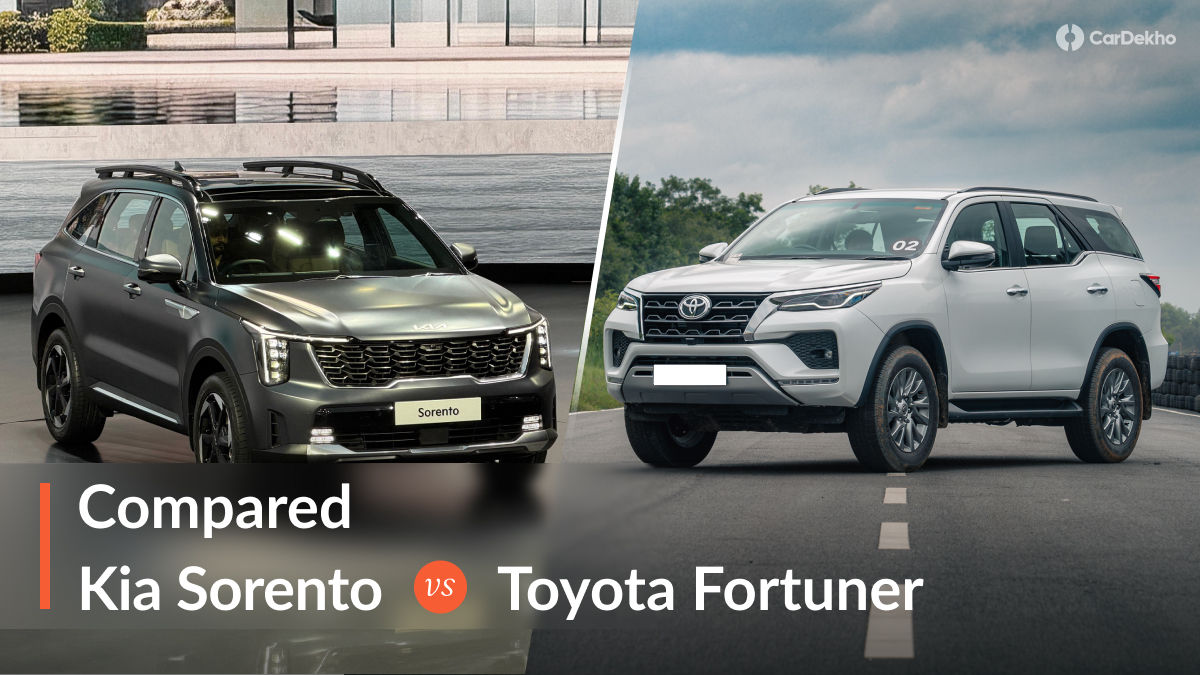
Kia recently made its debut in the 7-seater premium SUV segment with the launch of the Sorento. While the starting price of the Sorento is Rs 28 lakh (ex-showroom) onwards, it goes up against the likes of the Mahindra XUV 7XO all the way to the Toyota Fortuner and its peers.
The Sorento packs in a big list of features, big size and appeal. How does it match up against the Fortuner, and who is each for? Let’s explore.
Dimensions
| Model |
Kia Sorento |
Toyota Fortuner |
Difference |
| Length |
4,815 mm |
4,795 mm |
(+20 mm) |
| Width |
1,900 mm |
1,855 mm |
(+45 mm) |
| Height |
1,785 mm |
1,835 mm |
(-50 mm) |
| Wheelbase |
2,815 mm |
2,745 mm |
(+70 mm) |
-
The Sorento, despite being priced much lower, is larger in size in almost every dimension except in height.

-
The predominantly diesel-powered Fortuner comes with a much larger 80-litre fuel tank as opposed to the Sorento’s 67 litres. However, this should not make a big difference in the total range of each when considering the Sorento’s hybrid variant.
-
The Fortuner is available only with a 7-seater configuration, while the Sorento offers the option of 6- and 7-seater configurations.
Colours Available
| Kia Sorento |
Toyota Fortuner |
| Gravity Gray |
Super White |
| Imperial Blue |
Attitude Black |
| Pewter Olive |
Silver Metallic |
| Glacier White Pearl |
Grey Metallic |
| Dark Gun Metal (Matte) |
Avant-Garde Bronze |
| Aurora Black Pearl |
Phantom Brown |
| Magma Red |
White Pearl Crystal Shine |
| Ivory Silver (Glossy) |
Sparkling Black |
-
Both cars come with 8 colour options. However, it is the Sorento which comes with brighter and more interesting colour options as opposed to the Fortuner’s largely vanilla colour palette.
-
Another interesting difference is the availability of a matte finish paint option in the Sorento, which is reserved for the Dark Gun Metal colour.
-
Interestingly, despite the availability of the 8 colours, we mostly see only white and black Fortuners on our roads.
Exterior Features
| Feature |
Kia Sorento |
Toyota Fortuner |
| LED headlamps |
✅ |
✅ |
| LED DRLs |
✅ |
✅ |
| Sequential indicators |
✅ |
✅ |
| LED tail lamps |
✅ |
✅ |
| Rear spoiler |
✅ |
✅ |
| Roof rails |
✅ |
✅ |
| Alloy wheels |
18-inch/19-inch |
17-inch/18-inch |
| Power-folding ORVMs |
✅ |
✅ |
| LED ORVM indicators |
✅ |
✅ |
| Front fog lamps |
LED |
✅ |
-
Interestingly, despite the Fortuner being a larger-looking SUV, the wheel size is one inch smaller compared to the Sorento. This will be compensated for with tyres with fatter sidewalls to aid off-road ability.
-
Both SUVs get most of the modern amenities for the exterior.
-
While both get roof rails, the Sorento has larger-looking ones which add to its SUV looks.
Comfort & Convenience
| Feature |
Kia Sorento |
Toyota Fortuner |
| Leatherette seat upholstery |
✅ |
✅ |
| Driver seat |
10-way power / Ergo Motion on higher variants |
8-way adjustable |
| Front passenger seat |
6-way/8-way power depending on variant |
8-way adjustable |
| Ventilated front seats |
✅ |
✅ |
| Ventilated rear seats |
✅ |
✅ |
| Captain seats |
Available on 6-seater |
❌ |
| Digital instrument cluster |
12.3-inch |
TFT display |
| Infotainment screen |
12.3-inch |
8-inch |
| Ambient lighting |
64-colour |
❌ |
| Leatherette-wrapped steering wheel |
Yes |
✅ |
| Head-up display |
✅ |
❌ |
| Panoramic sunroof |
✅ |
❌ |
| Boss mode |
Yes |
❌ |
| Second-row seats |
60:40 split, slide and recline |
60:40 split, slide and recline |
| Third-row seats |
50:50 split |
Side-foldable |
| Climate control |
Dual-zone automatic |
Dual-zone automatic |
| Rear AC vents |
✅ |
✅ |
| Wireless charger |
✅ |
❌ |
| Cruise control |
Adaptive on higher variants |
Cruise control |
| Digital key |
✅ |
❌ |
| Connected car technology |
✅ |
✅ |
| OTA updates |
✅ |
❌ |
| Voice assistant |
Kia AI Assistant |
Voice recognition |
| Premium audio |
12-speaker sound system |
11-speaker JBL sound system |
| Powered tailgate |
✅ |
✅ |
| Remote parking assist |
✅ |
❌ |
| Drive modes |
Eco/Sport/Smart/Normal |
Eco/Normal/Sport |
| Off-road modes |
Snow/Mud/Sand on AWD |
4WD low/high range, DAC, A-TRC |
-
Despite the Fortuner being the more expensive SUV, it does not get many modern features which the Sorento gets.
-
The small TFT driver’s display on the Fortuner looks too basic for the price.
-
The Sorento offers better seating flexibility with the option of 6- and 7-seater configurations.
Safety
| Safety Feature |
Kia Sorento |
Toyota Fortuner |
| Airbags |
10 |
7 |
| ABS with EBD |
✅ |
✅ |
| ESC/VSC |
✅ |
✅ |
| Hill-start assist |
✅ |
✅ |
| Traction control |
✅ |
✅ |
| TPMS |
✅ |
❌ |
| ISOFIX |
✅ |
✅ |
| 360-degree camera |
✅ |
❌ |
| ADAS |
Level-2+ |
❌ |
| Blind-spot monitor |
✅ |
❌ |
| Front/rear parking sensors |
✅ |
✅ |
| Remote parking assist |
✅ |
❌ |
| 360-degree camera |
Yes |
❌ |
| Parking sensors |
Front/rear + side |
Front/rear |
| Downhill assist |
✅ |
✅ |
-
Despite the Sorento being a soft-roader SUV, it still packs in a good amount of off-road features compared to the more off-road-focused ladder-on-frame Fortuner.
-
Again, the Fortuner misses out on modern safety features like a tyre-pressure monitoring system, 360-degree camera, and a blind-spot monitor.
-
Meanwhile, the Sorento, in typical Kia fashion, does not skip in the safety list as well and provides a good list of active and passive safety features.
Powertrain
| Model |
Kia Sorento |
Toyota Fortuner |
||
| Engine |
1.6-litre turbo-petrol with strong-hybrid |
2.2-litre diesel |
2.7-litre naturally aspirated petrol |
2.8-litre diesel |
| Power |
180 PS engine + 65 PS motor |
193 PS |
166 PS |
204 PS |
| Torque |
265 Nm engine + 264 Nm motor |
442 Nm |
245 Nm |
500 Nm |
| Transmission |
6-speed AT |
8-speed DCT |
5-speed MT / 6-speed AT |
6-speed MT / 6-speed AT |
| Drivetrain |
FWD / AWD |
FWD / AWD |
2WD |
2WD / 4WD |
AT - Torque Converter (automatic), DCT - Dual-Clutch Transmission (automatic)
FWD - Front-Wheel-Drive, AWD - All-Wheel-Drive, 2WD - Two-Wheel-Drive (Rear), 4WD - Four-Wheel-Drive
-
One of the biggest differences between the two is also the approach in the drivetrain options. The Fortuner stays old-school, with larger-capacity naturally aspirated petrol and diesel 2WD and 4WD setups.
-
Meanwhile, the Sorento is for those who want a more refined experience and is more modern-day and city-friendly. In this case, the hybrid powertrain makes great sense.
-
The major difference between the AWD and FWD systems is the sensor-based usage and capability. The all-wheel drive setup in the Sorento predominantly uses only the front wheels, but activates the rear wheels when it needs extra traction. It has different traction modes to adapt and get out of tricky terrain. However, the Fortuner has low and high gearing and locking differentials for hardcore off-roading. All of these are manually operated when such settings are needed. Also, the Fortuner predominantly uses its rear wheels to drive the car by default.
CarDekho Says…
It is very apparent in this comparison that despite the two being roughly in a similar price bracket, both are designed for totally different types of people.
The Sorento is for those who like the modern comforts, features, refinement and practicality with reasonably good fuel economy. However, the Fortuner is for those who really subscribe to old-school motoring, which includes tough capability, don’t fancy many features and imposing looks.
While both are for different people, the Sorento does remind us that the Fortuner’s pricing is on the premium side given the technology and size that Kia offers with the Sorento.
Other Cars To Consider:
Mahindra XUV 7XO: This is among the popular options in the price segment. Packed with features, good stuling and powerful engine, this is also a great mile-mucher for people who like travelling.
MG Hector Tomahawk PHEV: This is the only plug-in hybrid SUV in the class. It can do over 100 km of claimed EV range and over 1000km as a petrol hybrid overall. This will appeal to people who likes a minimalist interior yet a feature rich one.
Jeep Meridian: This 7-seater SUV is best used as a 5-seater. The go anywhere SUV can take you long distance in comfort. However, this is available only with an ageing 2-litre diesel which isn't the best in refinement.
Tata Safari: The Safari is Tata's flagship SUV. Many have travelled long distances in the car and found the suspension and power reasonably good. However, Tata's reliablity and after sales leaves more to me desired.