

Government Mandates Mileage Testing for Cars With AC On And Off: Here’s What It Means for Indian Buyers
New fuel efficiency norms aim to bridge the gap between claimed and real-world mileage by factoring in air-conditioning usage


- Write a comment
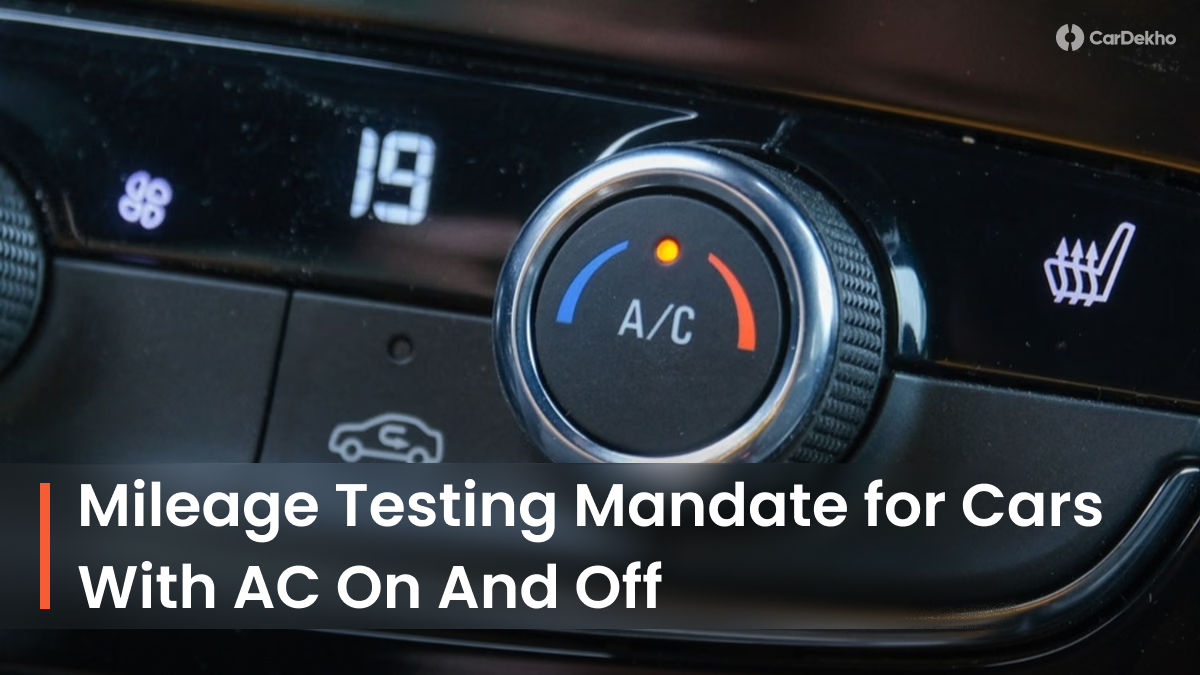
Wonder why claimed mileage figures and real-world numbers vary so much? Well, the Government might have just addressed one of the reasons behind it. In a move that could significantly change how fuel efficiency figures are presented in India, the Ministry of Road Transport and Highways has proposed mandatory testing of a vehicle’s fuel efficiency with the air-conditioning system both switched on and off.
The regulation, set to come into force from October 1, 2026, is designed to give car buyers a more realistic picture of a vehicle’s real-world fuel efficiency.
Let’s take a look at the proposal in detail:
What Has the Government Proposed?
Under the draft notification issued, all vehicles manufactured locally or imported into India will be required to undergo fuel efficiency testing under two conditions: one with the air-conditioning system switched off, and the other with the air-conditioning system switched on.

This rule will apply across powertrain types, including petrol, diesel, CNG, hybrid, and electric vehicles. Carmakers will be required to declare both sets of figures publicly, ensuring buyers know how much the AC affects consumption before making a purchase decision.
Once implemented, this regulation will mark a major shift from current testing practices, which only consider mileage figures recorded without AC usage.
Why Is AC Testing Being Made Mandatory?
The government’s logic behind this move is understandable and simple. It takes into consideration that cars are rarely driven without air-conditioning in India. Given the country’s climate, the AC is often switched on for a majority of the drive, especially in urban traffic and during summer months.
When the AC is operational, it places an additional load on the powertrain. In combustion-powered cars, the compressor draws power directly from the engine, increasing fuel consumption
In electric vehicles, the AC reduces driving range by consuming battery energy, thereby reducing your real-world range.
Officials have noted that this extra load leads to noticeably lower efficiency in real-world driving, something that is not reflected in current official mileage figures. The new testing requirement is meant to narrow this gap between the claimed numbers and on-road performance.
What Changes for Car Buyers?
For consumers, this regulation could be a game-changer. Starting from October 2026, buyers will be able to see two mileage figures for a vehicle, that is, with or without the AC turned on.
What this does is help buyers set more realistic expectations regarding fuel costs and also be able to compare vehicles more accurately. The difference and accurate information will be even more helpful in budget segments where running costs matter a lot.
The fact that you would get to know the difference between mileage with and without the AC will also give a clear picture of how a particular car performs in both conditions.
How Will Carmakers Need to Comply?
As per the draft notification, manufacturers and importers must conduct fuel efficiency testing using the AIS-213 testing standard and display mileage figures for both AC-on and AC-off conditions. They would have to publish these figures in user manuals, official websites, and other customer-facing materials such as brochures.
AIS-213 lays out detailed procedures for measuring emissions and fuel consumption while the air-conditioning system is operating, ensuring consistency across brands and models.
At present, fuel efficiency testing in India is conducted with the air-conditioning switched off, aligning with European testing cycles. However, government officials have pointed out that European climates and driving patterns differ significantly from Indian conditions. As a result, the officially claimed mileage often appears optimistic when compared to what owners experience in daily use.
The new mandate represents a shift towards India-specific regulations, tailored to local climate, traffic, and usage patterns rather than global averages.
Impact on Fuel Efficiency Figures
Fuel efficiency is something that depends on many factors, such as your engine health, driving style, road conditions, weather at that particular time, and the number of passengers and the load that the car is carrying. What we mean by this is that, even though the updated norms will help you get a more realistic idea of what to expect in terms of efficiency, the real-world mileage will still depend on many other parameters.
A post shared by CarDekho India (@cardekhoindia)
One can expect claimed mileage numbers to reduce by 1-2 kmpl. While this might feel negative at the beginning, it will be satisfying to see that real-world numbers are now closer to what the companies claim.
For EVs, one can expect an improved real-world range anywhere from 10 km to 30 km.
CarDekho Says…
The government’s proposal to mandate air-conditioning system testing represents a practical and consumer-focused reform. By acknowledging how vehicles are actually used on Indian roads, the move promises to bring greater transparency, trust, and realism to fuel efficiency claims.
While automakers may face short-term challenges, the long-term outcome could be more efficient vehicles, better-informed buyers, and mileage figures that finally match real-world experience. It would also help buyers get a realistic idea of their running costs, as many buyers still refer to official claimed mileage numbers before purchasing their cars.
Overall, it would be a positive outcome for the Indian auto industry. What do you think about the proposal? Let us know in the comments section below.
1 out of 1 found this helpful